




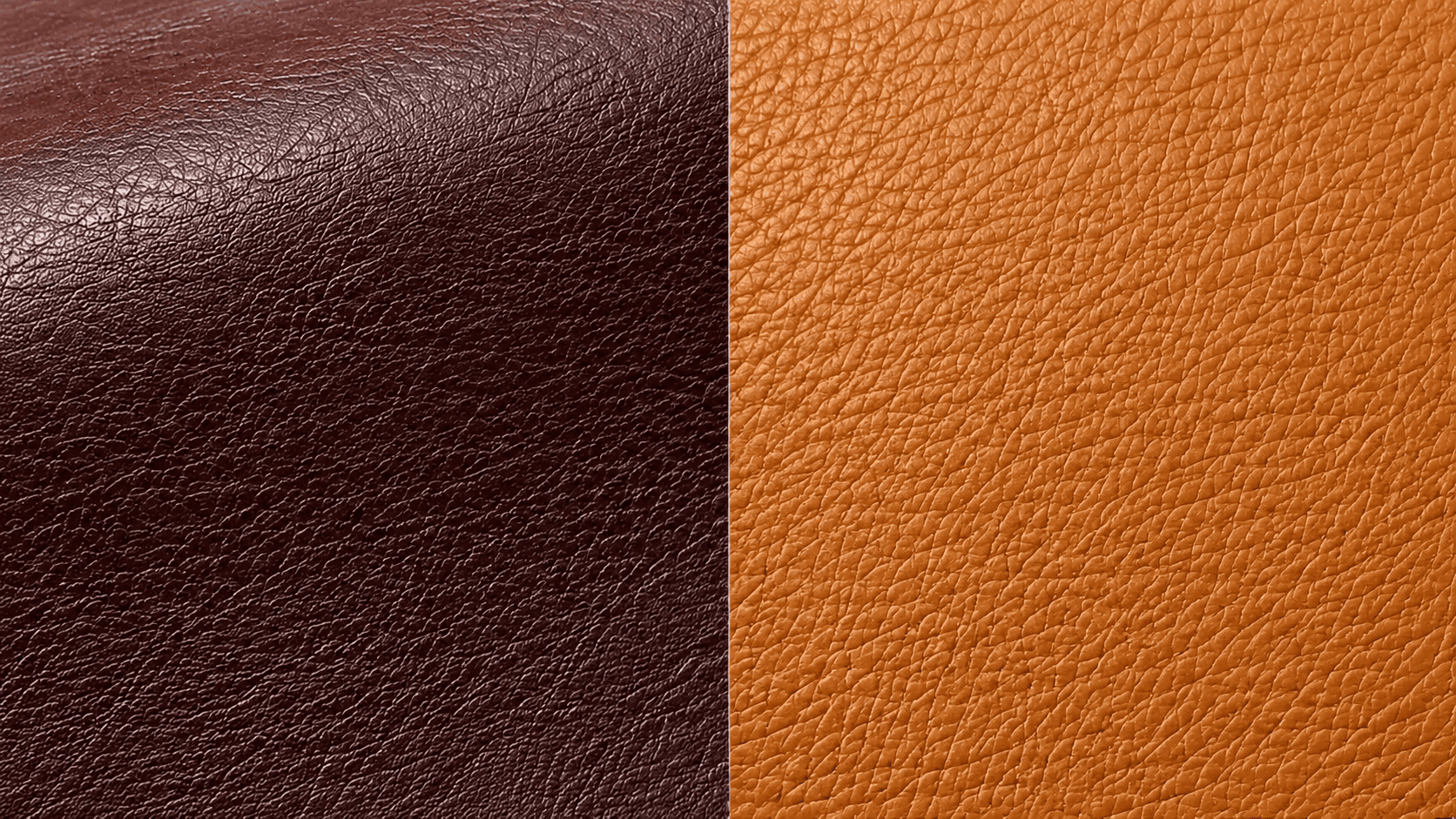
When sourcing leather products, one of the most common questions buyers ask is whether full grain leather or top grain leather is the better choice. Both are high-quality materials widely used in leather jackets, bags, wallets, belts, footwear, and furniture. However, they differ in appearance, durability, maintenance, and cost.
The right choice depends on your product requirements, target customers, and budget. This guide compares full grain and top grain leather to help you make an informed sourcing decision.
If you’re new to leather terminology, you may also find our Types of Leather Explained guide helpful for understanding the different leather types used across the industry.
What Is Full Grain Leather?
Full grain leather is the highest-quality leather because it retains the hide’s natural grain without sanding or buffing away surface imperfections.
Natural marks such as wrinkles or small scars remain visible, giving each piece a unique appearance. Since the strongest fiber layer stays intact, full grain leather offers outstanding durability and develops a rich patina with age.
Advantages
- Exceptional durability
- Natural appearance
- Develops a beautiful patina
- Excellent breathability
- Long service life
Limitations
- Higher cost
- Requires regular care
- Natural markings may not suit every design
Best Applications
- Premium leather jackets
- Luxury handbags
- High-end wallets
- Leather belts
- Boots
- Travel bags
What Is Top Grain Leather?
Top grain leather is made by lightly sanding or buffing the outer surface to remove natural imperfections. It is then finished with a protective coating that creates a smoother and more uniform appearance.
Although it loses part of the original grain, top grain leather remains one of the most popular choices for premium leather products.
Advantages
- Smooth and consistent finish
- Softer feel
- Easier to maintain
- Better stain resistance
- More uniform appearance
Limitations
- Does not develop the same patina as full grain leather
- Slightly lower durability
- Reduced breathability compared to full grain
Best Applications
- Fashion handbags
- Leather jackets
- Wallets
- Office bags
- Luxury accessories
- Upholstered furniture
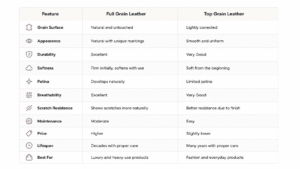
Full Grain vs Top Grain Leather: Side-by-Side Comparison
Key Differences Between Full Grain and Top Grain Leather
Grain Structure
Full grain leather keeps the original grain intact, while top grain leather has a lightly corrected surface for a cleaner appearance.
Surface Finish
Full grain has a natural look with visible markings. Top grain offers a more refined and consistent finish.
Durability
Full grain leather is generally more durable because its strongest fiber layer remains untouched.
Appearance
If you prefer a natural and authentic look, full grain leather is the better choice. For a cleaner and more polished finish, top grain leather is often preferred.
Aging
Full grain leather develops a rich patina that enhances its character over time. Top grain leather maintains a more consistent appearance but develops less patina.
Maintenance
Top grain leather is easier to clean because of its protective finish. Full grain leather requires slightly more care to maintain its natural beauty.
Cost
Full grain leather is usually more expensive due to the higher-quality hides required and minimal surface correction. Top grain leather offers a balance between quality and affordability.
Manufacturing Process
Full grain leather undergoes minimal surface treatment, while top grain leather is lightly sanded and finished to create a uniform appearance suitable for large-scale production.
Which Leather Is Better?
Neither leather is universally better. The right choice depends on your priorities.
Choose Full Grain Leather if you want:
- Maximum durability
- A natural appearance
- Long-term aging with a patina
- Premium product positioning
Choose Top Grain Leather if you want:
- A smoother finish
- Easier maintenance
- Consistent appearance
- Better value for many commercial products
For a broader explanation of leather quality classifications, read our guide on understanding of leather grades.
Which Leather Should You Choose?
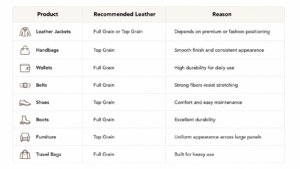
Buying Considerations for OEM and Private Label Brands
Before choosing a leather type, consider:
- Your target market
- Product pricing
- Brand positioning
- Expected durability
- Material consistency
- Sample approval before production
Many private label brands choose top grain leather for its consistent finish, while premium brands often select full grain leather to emphasize craftsmanship and longevity.
Common Myths About Full Grain and Top Grain Leather
Myth 1: Top Grain Leather Is Fake
No. Top grain leather is genuine leather that has been lightly corrected to improve its appearance.
Myth 2: Full Grain Leather Is Always the Best Choice
Not necessarily. The best leather depends on the product, customer expectations, and budget.
Myth 3: Top Grain Leather Doesn’t Last
High-quality top grain leather can provide many years of reliable performance when properly manufactured and maintained.
Myth 4: Higher Price Always Means Better Leather
Price reflects several factors, including hide quality, craftsmanship, finishing, and brand positioning, not just the leather type.
Expert Insights
Professional sourcing specialists often evaluate leather using four factors:
-
Fiber Integrity
The more natural fiber structure retained, the stronger the leather.
Full grain wins.
-
Consistency
For large-scale manufacturing consistency matters.
Top grain wins.
-
Brand Positioning
Luxury heritage brands often choose full grain.
Fashion-focused brands frequently choose top grain.
-
Customer Expectations
Business buyers should align material selection with customer expectations rather than industry trends.
A premium heritage backpack buyer may prefer visible grain and natural markings.
A luxury handbag buyer may prefer flawless uniformity.
Buying Advice
Before selecting leather, ask suppliers:
- Is the leather full grain or top grain?
- What tanning method was used?
- Which country produced the leather?
- Is the finish pigmented or aniline?
- What thickness is supplied?
- What certifications exist?
- Can sample swatches be provided?
- What is the expected lifespan?
- What maintenance is recommended?
- Is the leather suitable for my climate and usage requirements?
For importers and sourcing professionals, supplier transparency is often a stronger indicator of quality than marketing terminology.
Conclusion
Both full grain and top grain leather are excellent materials used in premium leather products. Full grain leather offers superior durability, natural character, and long-term aging, while top grain leather provides a refined appearance, easier maintenance, and greater consistency.
Rather than asking which leather is better, buyers should consider which material best fits their product, customers, and budget. Evaluating both the leather and the manufacturer’s production standards will lead to better sourcing decisions.
For a broader overview of leather materials, manufacturing, and sourcing, explore our complete leather guide.
Frequently Asked Questions
Is full grain leather better than top grain leather?
Full grain leather is generally more durable and develops a natural patina, but top grain leather offers a smoother appearance and easier maintenance.
Is full grain leather the best leather type?
Generally yes. Full grain leather is widely regarded as the highest-quality leather due to its strength, durability, and ability to develop patina.
Is top grain leather real leather?
Yes. Top grain leather is genuine leather made from the upper portion of the hide.
Why is full grain leather more expensive?
It requires higher-quality hides and preserves the strongest grain structure.
Does top grain leather crack?
High-quality top grain leather can last many years without cracking when properly maintained.
Which leather lasts longer?
Full grain leather generally lasts longer.
Is top grain leather good for bags?
Yes. Many premium handbags use top grain leather because of its consistent appearance.
Does full grain leather scratch easily?
It can show scratches more readily, but many marks blend naturally into the developing patina.
Which leather is better for jackets?
Both are excellent. Full grain offers durability and character, while top grain provides a smoother appearance.
Which leather is better for furniture?
Top grain leather is often preferred because of its consistency and ease of maintenance.
Is full grain leather waterproof?
No. It is water resistant but not waterproof.
What leather do luxury brands use?
Many use both full grain and top grain leather depending on product design and brand positioning.
Can top grain leather develop patina?
Yes, but usually less dramatically than full grain leather.