




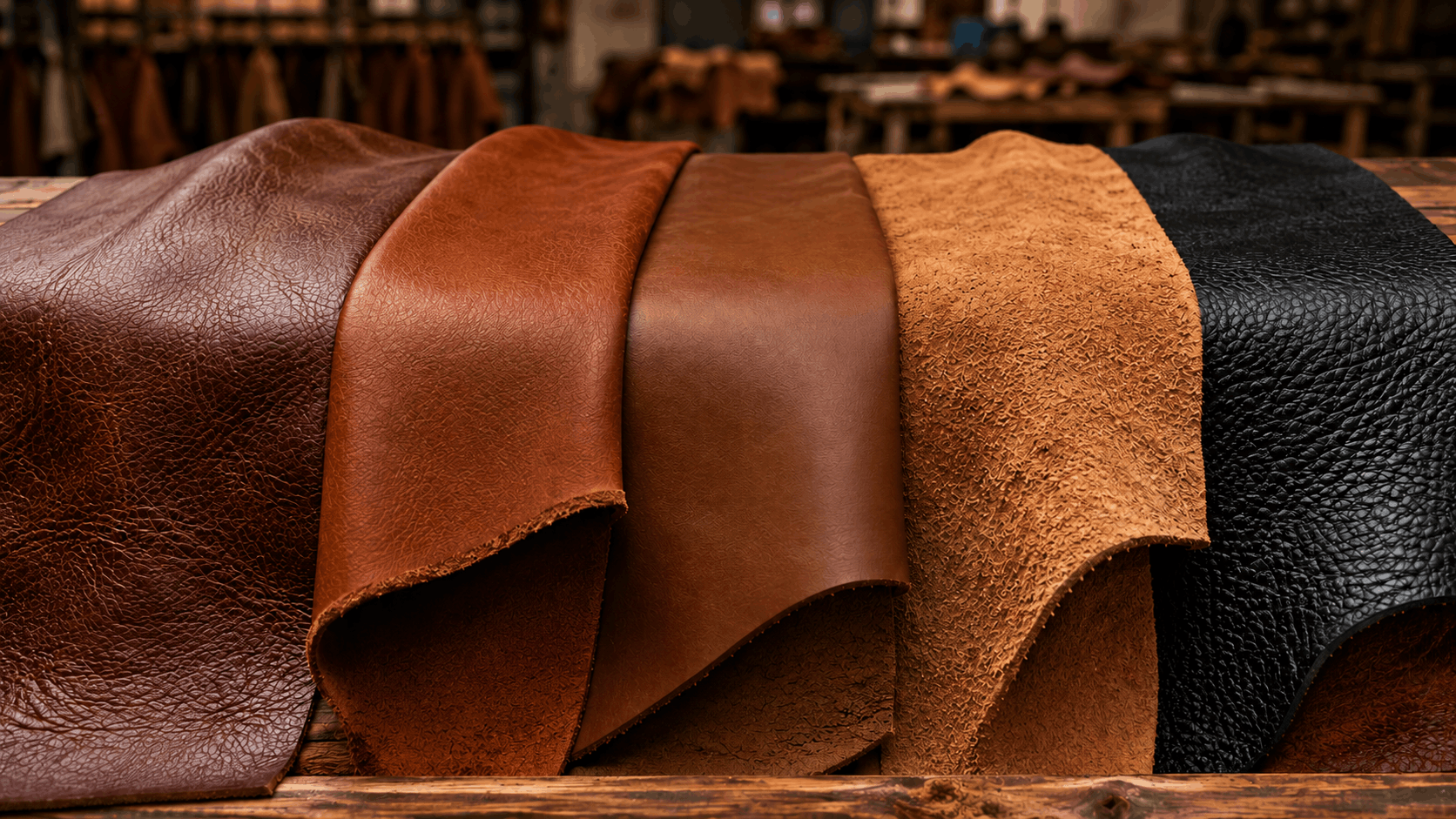
Leather is one of the few materials whose value depends as much on how it is made as on what it is made from. Terms such as full grain, top grain, and genuine leather are widely used in product descriptions, yet they are often misunderstood by buyers and sometimes used inconsistently by sellers. As a result, two products labeled as “genuine leather” can differ significantly in durability, appearance, and long-term performance.
For importers, private label brands, and procurement teams, understanding leather grades is an essential part of supplier evaluation. Leather grade provides insight into the structure of the hide and the amount of processing it has undergone, but it is only one aspect of quality. The origin of the raw hide, tanning process, finishing techniques, craftsmanship, and quality control procedures all influence the final product.
When sourcing leather jackets, bags, wallets, belts, footwear, or other leather goods, relying solely on grade can lead to costly purchasing mistakes. A well-manufactured top grain leather product may outperform a poorly processed full grain alternative if the manufacturer uses higher quality hides, better tanning methods, and stricter production standards.
This guide explains how leather grades are commonly understood within the industry, how leather quality is evaluated, and what international buyers should examine before selecting a leather manufacturer.
What Are Leather Grades?
Leather grades describe the quality and characteristics of leather based on the portion of the hide used and the amount of processing applied during manufacturing. They help manufacturers, buyers, and product developers distinguish between different types of leather, although it is important to note that there is no single internationally regulated leather grading system.
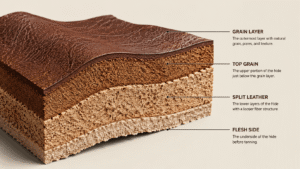
Instead, manufacturers, tanneries, and buyers often use widely accepted industry terminology to communicate the expected appearance, durability, and performance of leather.
Leather Grade vs. Leather Quality
One of the most common misconceptions is that leather grade and leather quality mean the same thing.
They do not.
A leather grade refers primarily to the structure of the leather and how much of the natural grain remains intact. Leather quality is broader and includes factors such as:
- Raw hide selection
- Animal health
- Fiber density
- Tanning process
- Dye penetration
- Surface finishing
- Cutting and stitching quality
- Hardware selection
- Final product construction
For example, two manufacturers may both produce full grain leather jackets. One may source premium European cattle hides with minimal defects and apply high-quality vegetable tanning, while another may use lower-grade hides with inconsistent finishing. Although both products are technically full grain leather, their performance, appearance, and lifespan can differ substantially.
This distinction is especially important for businesses sourcing products through OEM or private label manufacturing, where manufacturing standards vary between suppliers.
Why Leather Grades Matter for Buyers
Understanding leather grades helps buyers make informed sourcing decisions instead of relying on marketing claims.
A clear understanding of leather grades allows buyers to:
- Compare product specifications across suppliers.
- Match leather type to the intended application.
- Evaluate pricing differences more accurately.
- Set realistic quality expectations.
- Communicate technical requirements during OEM production.
- Reduce disputes related to material quality.
For example, an outdoor equipment brand may prioritize durability and abrasion resistance, making full grain leather a suitable choice for heavy-duty products. A fashion brand focused on a smooth, uniform appearance may prefer top grain leather because of its refined finish.
Selecting the appropriate leather grade depends on the product’s intended use rather than assuming one grade is universally better.
Common Leather Grade Terminology
The leather industry commonly refers to five primary categories:
| Leather Grade | General Characteristics | Typical Applications |
| Full Grain Leather | Natural grain remains intact with minimal surface correction | Premium jackets, boots, luxury bags, belts |
| Top Grain Leather | Sanded or lightly corrected surface for a more uniform appearance | Fashion accessories, handbags, furniture |
| Genuine Leather | Leather made from real animal hide but with varying quality depending on processing | Wallets, belts, footwear, accessories |
| Split Leather | Produced from the lower layers of the hide after separating the grain | Suede products, work gloves, economical goods |
| Bonded Leather | Manufactured from leather fibers combined with adhesives and finished with a coating | Decorative products, low-cost furniture, book covers |
These terms provide a general framework, but buyers should always request detailed material specifications rather than relying solely on grade descriptions.
How Leather Quality Is Evaluated
Leather grade provides a starting point, but experienced buyers and manufacturers evaluate leather using a broader set of quality indicators. During sourcing, these factors often have a greater impact on the final product than the grade itself.
1. Raw Hide Selection
Quality begins before the tanning process.
The condition of the raw hide significantly influences the finished leather. Hides with fewer scars, insect bites, branding marks, or excessive wrinkles generally produce cleaner, more consistent leather.
Factors affecting hide quality include:
- Animal species
- Age of the animal
- Health and nutrition
- Climate
- Farm management practices
- Hide preservation after slaughter
Premium manufacturers often source hides from regions known for consistent livestock quality and strong traceability systems.
2. Grain Structure
The grain layer is the strongest part of the hide because it contains densely packed collagen fibers.
Leather with an intact grain structure typically offers:
- Better durability
- Higher tear resistance
- Improved abrasion resistance
- Greater flexibility
- Better aging characteristics
Excessive sanding or correction can improve cosmetic appearance but may reduce some of these natural performance characteristics.
3. Fiber Density
Leather is made up of intertwined collagen fibers. Their density influences strength, shape retention, and resistance to stretching.
Dense fiber structures are especially important for products such as:
- Leather jackets
- Motorcycle apparel
- Work gloves
- Tactical gear
- Safety footwear
- Travel bags
Manufacturers often select different sections of the hide depending on the product’s functional requirements.
4. Tanning Process
Tanning stabilizes the hide and transforms it into durable leather. The chosen tanning method affects appearance, flexibility, maintenance, and aging.
The two most common tanning methods are:
Vegetable Tanning
Vegetable tanning uses natural tannins extracted from plants and tree bark.
Characteristics include:
- Rich natural appearance
- Excellent patina development
- Firmer structure
- Longer production time
- Preferred for premium belts, wallets, and luxury accessories
Chrome Tanning
Chrome tanning uses chromium salts to produce soft, flexible leather efficiently.
Characteristics include:
- Faster production
- Soft hand feel
- Excellent color consistency
- High flexibility
- Commonly used for jackets, handbags, upholstery, and footwear
The choice of tanning depends on the intended product rather than indicating superior or inferior quality.
5. Surface Finishing
After tanning, leather may undergo additional finishing processes that influence its appearance and performance.
Common finishing techniques include:
- Aniline finishing
- Semi-aniline finishing
- Pigmented finishing
- Embossing
- Protective coatings
- Wax finishing
- Oil finishing
A heavily finished leather may provide improved stain resistance and color consistency, while lightly finished leather often preserves more of the natural grain.
6. Thickness and Consistency
Leather thickness affects both performance and usability.
For example:
- Lightweight fashion jackets require thinner, softer leather.
- Work boots require thicker leather for protection.
- Belts require dense, rigid leather to resist stretching.
- Upholstery leather requires consistent thickness across large panels.
Manufacturers measure thickness carefully to ensure consistency across production batches.
7. Dye Penetration and Color Consistency
High-quality leather demonstrates even dye penetration and consistent coloration throughout production.
During supplier evaluation, buyers should inspect samples for:
- Uniform color
- Clean edges
- Minimal shade variation
- Smooth transitions between panels
- Resistance to color transfer
Color consistency is particularly important for bulk OEM orders where products must match across multiple production runs.
8. Manufacturing and Quality Control
Even premium leather can result in a poor-quality product if manufacturing standards are inconsistent.
Experienced buyers evaluate:
- Stitch density and alignment
- Seam strength
- Edge finishing
- Hardware quality
- Lining materials
- Reinforcement at stress points
- Pattern accuracy
- Final product inspection procedures
Manufacturers with documented quality control systems are generally better equipped to deliver consistent results at scale.
Key Insight for Buyers
Leather grade should never be used as the sole measure of quality. A comprehensive evaluation considers the raw hide, grain integrity, tanning process, finishing methods, fiber structure, and manufacturing practices. Buyers who assess these factors alongside leather grade are better positioned to select reliable suppliers and source products that meet their quality, durability, and brand expectations.
The next section explores the five main leather grades in detail, explaining their characteristics, advantages, limitations, and the product categories for which each is best suited.
Understanding the Five Main Leather Grades
Leather grades refer to the layer of the hide used and the level of processing applied during manufacturing. While they influence a product’s appearance, durability, and cost, leather grade is only one aspect of overall leather quality. Factors such as hide selection, tanning, finishing, and manufacturing standards also play a significant role.
The five most commonly recognized leather grades are:
– Full Grain Leather
Full grain leather is widely regarded as the highest-quality leather because it retains the hide’s natural grain layer. Unlike other grades, its surface is not sanded or buffed to remove natural markings. Small scars, wrinkles, and insect bites may remain visible, reflecting the authenticity of the material.
The dense fiber structure in the grain layer provides excellent strength, making full grain leather suitable for products expected to withstand years of regular use.
– Top Grain Leather
Top grain leather is produced by lightly sanding or buffing the outer surface to remove imperfections. A protective finish is then applied to create a smoother and more uniform appearance.
Although it no longer retains the completely natural grain, top grain leather remains a high-quality material and is widely used in commercial manufacturing.
Many luxury fashion brands choose top grain leather because it offers visual consistency across large production runs.
– Genuine Leather
Few terms create more confusion than “genuine leather.”
Many consumers assume genuine leather represents premium quality because the name suggests authenticity. In reality, genuine leather simply indicates that the material comes from real animal hide.
It does not describe the quality level.
Genuine leather is often produced from layers beneath the full grain or top grain surface. Manufacturers usually apply pigments, embossing, or protective finishes to improve appearance.
Depending on the tannery and manufacturing process, genuine leather can range from acceptable quality to relatively low durability.
– Split Leather
Split leather comes from the lower layers of the hide after the grain layer has been separated.
Without the dense natural grain, split leather has lower strength than full grain or top grain leather. However, it remains useful for many products where softness or cost efficiency is more important than maximum durability.
When buffed, split leather often becomes suede.
Some manufacturers emboss polyurethane coatings onto split leather to imitate full grain leather.
– Bonded Leather
Bonded leather differs significantly from the other grades.
Rather than being cut directly from a hide, bonded leather is manufactured by combining leather fibers and scraps with adhesives. The mixture is compressed into sheets and coated with polyurethane or similar materials to resemble natural leather.
Because it contains only a percentage of leather fibers, bonded leather generally offers the lowest durability among commonly available leather materials.
If you’d like to explore the characteristics, manufacturing process, advantages, disadvantages, and common uses of each leather grade in greater detail, read our comprehensive guide: Types of Leather Explained.
Leather Grades Comparison Table
| Feature | Full Grain | Top Grain | Genuine | Split Leather | Bonded Leather |
| Natural Grain | Fully intact | Lightly corrected | Usually corrected | Removed | No |
| Durability | Excellent | Very Good | Moderate | Moderate to Low | Low |
| Appearance | Natural | Uniform | Finished | Soft or suede-like | Artificial |
| Patina Development | Excellent | Limited | Minimal | Minimal | None |
| Abrasion Resistance | Excellent | Very Good | Moderate | Moderate | Poor |
| Flexibility | Excellent | Excellent | Good | Good | Moderate |
| Maintenance | Moderate | Easy | Easy | Moderate | Easy |
| Price Range | Highest | High | Mid-range | Lower | Lowest |
| Typical Lifespan | Decades with proper care | Many years | Varies | Moderate | Short |
| Best For | Luxury goods, premium jackets, boots | Fashion products, handbags, furniture | Everyday accessories | Suede products, gloves | Decorative and budget products |
Which Leather Grade Is Best?
There is no universal answer.
The best leather grade depends on the intended product, target market, budget, and performance expectations.
| Product Category | Recommended Leather Grade | Reason |
| Luxury Jackets | Full Grain | Maximum durability and natural appearance |
| Fashion Jackets | Top Grain | Consistent finish with good durability |
| Premium Bags | Full Grain or Top Grain | Balance of appearance and performance |
| Wallets | Full Grain or Top Grain | Frequent handling requires durable leather |
| Belts | Full Grain | Dense fibers resist stretching |
| Work Gloves | Split Leather | Cost-effective with sufficient flexibility |
| Suede Products | Split Leather | Soft texture required |
| Budget Furniture | Bonded Leather | Lower production cost |
| Luxury Furniture | Top Grain | Uniform appearance and long service life |
Practical Advice for International Buyers
Leather grade should be viewed as one factor within a broader material evaluation process. Experienced sourcing professionals rarely approve leather based on terminology alone.
Before placing an OEM or private label order, buyers should request:
- Physical leather swatches from the production batch
- Material specifications, including thickness and tanning method
- Information on hide origin
- Performance test reports where applicable
- Color consistency samples
- Production references for similar products
- Details of finishing techniques
- Quality control procedures followed during manufacturing
Comparing suppliers on these criteria provides a more accurate assessment than relying solely on labels such as “full grain” or “genuine leather.”
Understanding the characteristics, strengths, and limitations of each leather grade enables buyers to select materials that align with their product requirements, pricing strategy, and brand positioning. The next section explores how leather quality standards, inspection methods, and international testing practices help verify that the chosen material meets commercial expectations.
Leather Grades vs. Leather Quality Standards
Understanding leather grades is only one part of evaluating leather products. While grades describe the structure of the leather, quality standards determine whether the material meets specific performance, durability, safety, and manufacturing requirements.
For international buyers, relying solely on terms such as full grain leather or top grain leather is rarely sufficient. Professional sourcing decisions should also consider measurable quality indicators, factory quality control systems, and compliance with relevant testing standards.
In global trade, leather quality is assessed through a combination of visual inspection, laboratory testing, manufacturing consistency, and documentation provided by the supplier.
Why Leather Grades Are Not Globally Standardized
One of the biggest misconceptions in the leather industry is that leather grades follow a universal international classification.
In reality, there is no globally recognized grading authority that defines terms such as full grain, top grain, or genuine leather. These classifications are widely accepted within the industry, but manufacturers and tanneries may interpret or market them differently.
For example:
- Two suppliers may both offer full grain leather, yet the hides, tanning methods, and finishing processes can differ significantly.
- A supplier may describe a product as genuine leather without specifying whether it is made from grain leather or split leather.
- Different countries may use slightly different terminology depending on local manufacturing practices.
Because of these variations, buyers should always request detailed material specifications rather than relying on product descriptions alone.
What Determines Leather Quality Beyond Grade?
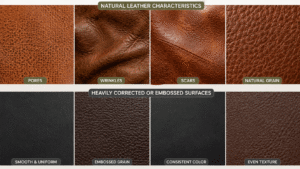
Leather quality is influenced by every stage of the manufacturing process, from raw hide selection to final product inspection.
1. Hide Quality
The foundation of quality starts with the raw hide.
Premium hides typically have:
- Minimal scars
- Few insect bites
- Limited branding marks
- Uniform thickness
- Strong fiber structure
Inferior hides often require more corrective finishing, which can affect both appearance and durability.
2. Tanning Quality
A well-executed tanning process stabilizes collagen fibers, improves durability, and enhances flexibility.
Poor tanning may lead to:
- Uneven color
- Cracking
- Premature aging
- Weak structural performance
- Reduced water resistance
Experienced buyers often ask suppliers about their tanning methods and the tannery responsible for processing the hides.
3. Dye Penetration
High-quality leather should exhibit consistent color throughout the material rather than only on the surface.
Deep dye penetration generally provides:
- Better scratch resistance
- More natural aging
- Improved color consistency
- Enhanced appearance over time
4. Surface Finishing
The finishing process protects leather and influences its visual appeal.
Manufacturers may use:
- Aniline finishes
- Semi-aniline finishes
- Pigmented coatings
- Wax treatments
- Oil finishes
- Protective topcoats
The appropriate finish depends on the intended application rather than indicating higher or lower quality.
5. Product Construction
Even premium leather cannot compensate for poor manufacturing.
Buyers should inspect:
- Stitch consistency
- Seam alignment
- Reinforcement at stress points
- Edge finishing
- Hardware quality
- Lining materials
- Pattern accuracy
A well-constructed top grain leather bag may outperform a poorly assembled full grain alternative.
International Leather Quality Standards
International buyers often request compliance with recognized testing standards to ensure consistency across production batches.
Although requirements vary by product category and destination market, manufacturers commonly evaluate leather using standardized physical and chemical tests.
Common Physical Performance Tests
| Test | Purpose |
| Tensile Strength | Measures the force leather can withstand before breaking. |
| Tear Strength | Evaluates resistance to tearing under stress. |
| Flex Resistance | Determines how well leather performs after repeated bending. |
| Abrasion Resistance | Assesses resistance to surface wear from friction. |
| Seam Strength | Measures durability of stitched construction. |
| Color Fastness | Evaluates resistance to fading or color transfer. |
| Thickness Consistency | Confirms uniform material thickness across production. |
These tests help buyers compare materials objectively instead of relying on visual appearance alone.
Chemical Compliance
Many international markets require leather products to comply with chemical safety regulations.
Manufacturers exporting to Europe, North America, and other regulated markets often test for:
- Restricted substances
- Heavy metals
- Formaldehyde
- Chromium VI
- Azo dyes
- pH balance
Compliance demonstrates that products meet applicable market requirements and reduces the risk of shipment rejection.
Traceability and Documentation
Professional manufacturers should be able to provide documentation such as:
- Material specifications
- Leather thickness reports
- Production records
- Quality inspection reports
- Batch identification
- Testing certificates (when requested)
Good documentation reflects a structured quality management process and improves transparency between buyers and suppliers.
How Buyers Can Verify Leather Quality
Evaluating leather requires more than reviewing a supplier’s catalog. Buyers should verify material quality before approving samples or placing production orders.
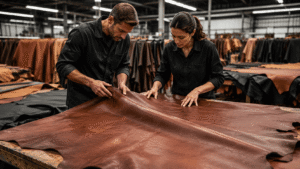
Request Material Samples
Before confirming production:
- Compare multiple leather options.
- Evaluate texture and flexibility.
- Inspect both finished and unfinished surfaces.
- Review different colors if consistency is important.
Sampling reduces the likelihood of unexpected variations during mass production.
Inspect the Grain
Natural grain should display subtle variations rather than perfectly identical patterns.
Look for:
- Natural wrinkles
- Small pores
- Fine grain texture
- Consistent surface quality
Artificial embossing often produces repetitive patterns that appear overly uniform.
Check Leather Thickness
Thickness should match the intended product.
Examples include:
| Product | Typical Leather Thickness |
| Wallets | 0.8 to 1.2 mm |
| Fashion Jackets | 0.8 to 1.1 mm |
| Motorcycle Jackets | 1.1 to 1.4 mm |
| Belts | 3.0 to 4.5 mm |
| Bags | 1.4 to 2.2 mm |
| Work Gloves | 0.9 to 1.3 mm |
Uniform thickness contributes to product consistency and manufacturing efficiency.
Evaluate Flexibility
Fold the leather gently.
Quality leather should:
- Bend naturally
- Recover its shape
- Show minimal surface cracking
- Feel supple without excessive stiffness
Poorly processed leather may crease sharply or show signs of coating failure.
Assess Stitching and Construction
When evaluating finished products, inspect:
- Straight stitching
- Consistent stitch density
- Reinforced handles
- Clean edge finishing
- Secure hardware installation
- Accurate panel alignment
Construction quality often reveals the manufacturer’s overall production standards.
Review Quality Control Procedures
Ask suppliers about their inspection process.
Questions may include:
- Are hides inspected before cutting?
- Is in-process quality control performed?
- Are finished goods inspected individually or by batch?
- How are defective products handled?
- Are quality reports available upon request?
Reliable manufacturers usually have documented procedures for each production stage.
Common Mistakes Buyers Make When Evaluating Leather
Even experienced buyers can overlook factors that affect product quality.
Assuming Genuine Leather Means Premium Leather
“Genuine leather” simply indicates that the material comes from real animal hides. It does not guarantee superior durability or craftsmanship.
Choosing the Lowest Price
Extremely low pricing may indicate:
- Lower-grade hides
- Inferior finishing
- Reduced quality control
- Lower-quality hardware
- Inconsistent production standards
Evaluating total value is more effective than comparing unit price alone.
Ignoring Sample Approval
Skipping the sampling stage increases the risk of:
- Color mismatches
- Material inconsistencies
- Construction defects
- Unexpected finishing differences
A production sample should always be approved before mass manufacturing begins.
Focusing Only on Leather
A leather product is a combination of multiple components.
Buyers should also evaluate:
- Zippers
- Buckles
- Threads
- Lining
- Reinforcement materials
- Packaging
- Branding elements
These components significantly influence the final product’s quality and customer experience.
Not Verifying Manufacturing Capability
Some suppliers outsource portions of production to subcontractors.
Before placing large orders, buyers should understand:
- Production capacity
- Lead times
- Quality management systems
- Previous export experience
- OEM capabilities
- Private label experience
Factory transparency reduces sourcing risks and improves long-term supplier relationships.
Choosing the Right Leather Grade for Different Products
Selecting the appropriate leather depends on product function, customer expectations, and price positioning.
| Product Category | Recommended Grade | Why It Works |
| Luxury Jackets | Full Grain | Superior durability and natural appearance |
| Premium Handbags | Full Grain or Top Grain | Strong structure with refined aesthetics |
| Fashion Accessories | Top Grain | Consistent finish and easier maintenance |
| Wallets | Full Grain or Top Grain | Durable enough for everyday use |
| Belts | Full Grain | Dense fibers resist stretching and cracking |
| Work Gloves | Split Leather | Cost-effective and flexible |
| Suede Products | Split Leather | Soft texture and distinctive finish |
| Budget Furniture | Bonded Leather | Suitable for cost-sensitive applications |
| Luxury Furniture | Top Grain | Better appearance, comfort, and longevity |
Rather than selecting the highest leather grade by default, buyers should match the material to the product’s intended use, target customer, and expected lifespan.
Tannorium Insight
Successful leather sourcing is based on informed decision-making rather than product labels alone. While understanding leather grades provides a valuable starting point, experienced buyers also evaluate manufacturing capabilities, quality control systems, sampling procedures, and supplier transparency before committing to production.
As a global leather marketplace, Tannorium helps buyers explore manufacturers and suppliers while providing educational resources that support better sourcing decisions. By combining material knowledge with careful supplier evaluation, businesses can reduce sourcing risks, improve product consistency, and build long-term manufacturing partnerships.
Transition to the Final Section
With a clear understanding of leather grades, quality standards, and inspection practices, buyers are better equipped to evaluate suppliers and choose materials that align with their product requirements. The final section answers frequently asked questions, highlights key takeaways, identifies featured snippet opportunities, recommends structured data, and outlines internal linking and AI optimization strategies to maximize the article’s value for both readers and search engines.
Frequently Asked Questions (FAQs)
1. What are leather grades?
Leather grades classify leather based on the layer of the hide used and the amount of processing applied during manufacturing. The most commonly recognized grades are full grain, top grain, genuine leather, split leather, and bonded leather. While these terms are widely used in the leather industry, they are not governed by a universal international grading system.
2. Which leather grade is the highest quality?
Full grain leather is generally considered the highest-quality leather because it retains the natural grain layer, offering excellent durability, strength, and the ability to develop a rich patina over time. However, the overall quality of a leather product also depends on factors such as hide selection, tanning, finishing, and manufacturing.
3. Is genuine leather real leather?
Yes. Genuine leather is made from real animal hide. However, the term does not indicate premium quality. Genuine leather can vary significantly depending on the portion of the hide used, processing methods, and manufacturing standards.
4. What is the difference between full grain and top grain leather?
Full grain leather retains the natural surface of the hide, including its original grain and markings. Top grain leather is lightly sanded or buffed to remove imperfections, creating a more uniform appearance. While both are high-quality materials, full grain leather is generally more durable and develops a natural patina with age.
5. Does leather grade determine product quality?
No. Leather grade is only one factor in determining quality. Buyers should also evaluate:
- Hide quality
- Tanning method
- Fiber density
- Leather thickness
- Surface finishing
- Product construction
- Hardware quality
- Factory quality control
A well-made top grain leather product can outperform a poorly manufactured full grain product.
6. Is bonded leather considered genuine leather?
Bonded leather contains leather fibers combined with adhesives and other materials. Although it includes some leather content, it is manufactured differently from natural leather and generally offers lower durability and a shorter lifespan.
7. Which leather grade is best for leather jackets?
For premium jackets, full grain leather provides exceptional durability and develops character over time. Top grain leather is also widely used because it offers a smooth appearance, consistent finish, and softer feel, making it suitable for many fashion and luxury applications.
8. How can buyers verify leather quality before placing an order?
Buyers should request material samples, review technical specifications, inspect grain texture, confirm leather thickness, evaluate stitching quality, and ask for quality control documentation. For larger orders, laboratory testing and factory audits may provide additional assurance.
9. Are leather grades internationally standardized?
No. There is no globally recognized organization that defines leather grades. Manufacturers and suppliers commonly use industry-accepted terminology, but buyers should always request detailed material specifications rather than relying solely on grade descriptions.
10. What should OEM and private label buyers ask suppliers?
Before placing production orders, buyers should request information about:
- Leather grade
- Hide origin
- Tanning method
- Thickness specifications
- Surface finishing
- Quality control procedures
- Production capacity
- MOQ
- Lead times
- Previous export experience
These details help evaluate both the material and the manufacturer’s capabilities.
Conclusion
Understanding leather grades is only the first step toward sourcing high-quality leather products. Successful procurement also depends on evaluating supplier capabilities, manufacturing processes, quality control systems, and production consistency.
If you’re looking to connect with verified leather manufacturers, compare sourcing options, or learn more about OEM and private label production, explore Tannorium’s growing network of suppliers and educational resources. Building strong sourcing partnerships begins with informed decisions backed by reliable industry knowledge.
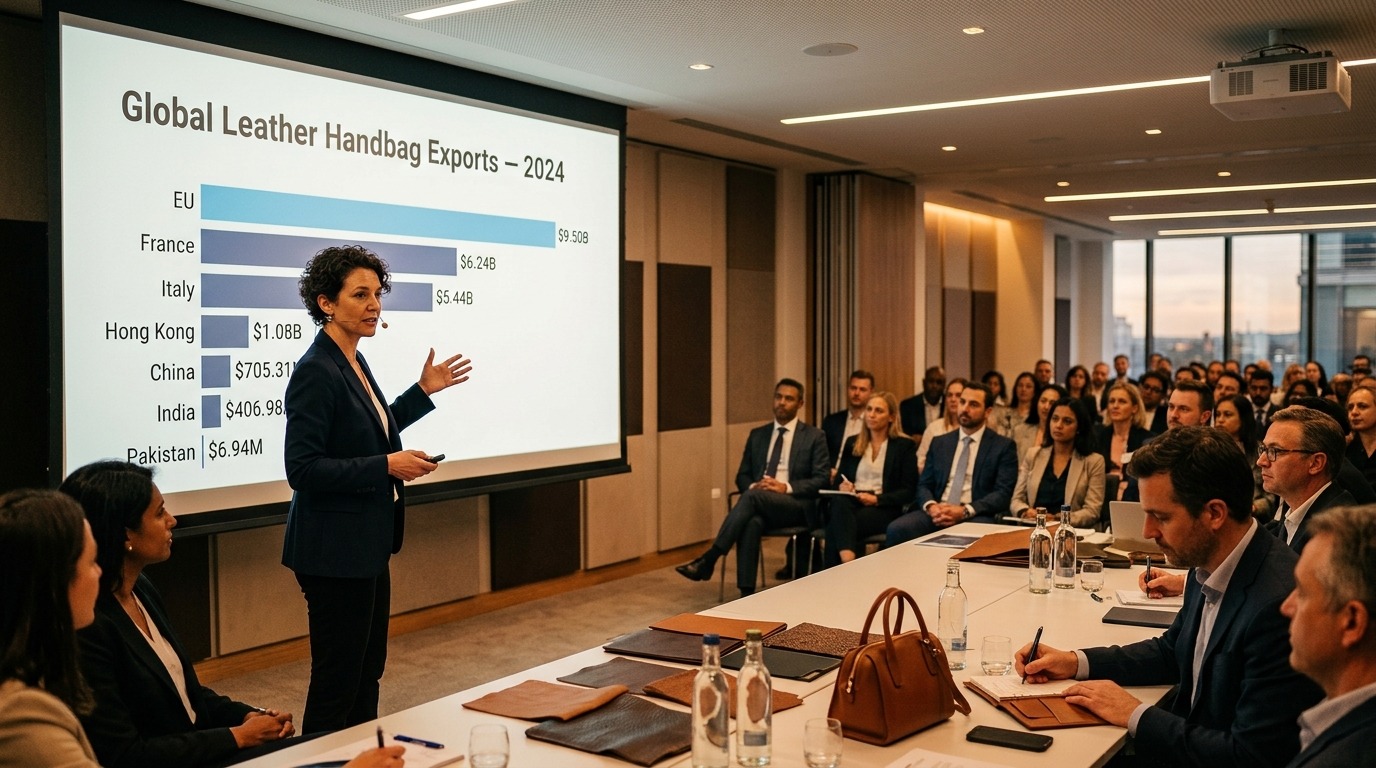
Global Leather Bags Trade Report: Imports, Exports & Top Markets

Global leather bags trade report data shows that international trade in leather handbags is concentrated among a relatively s...