




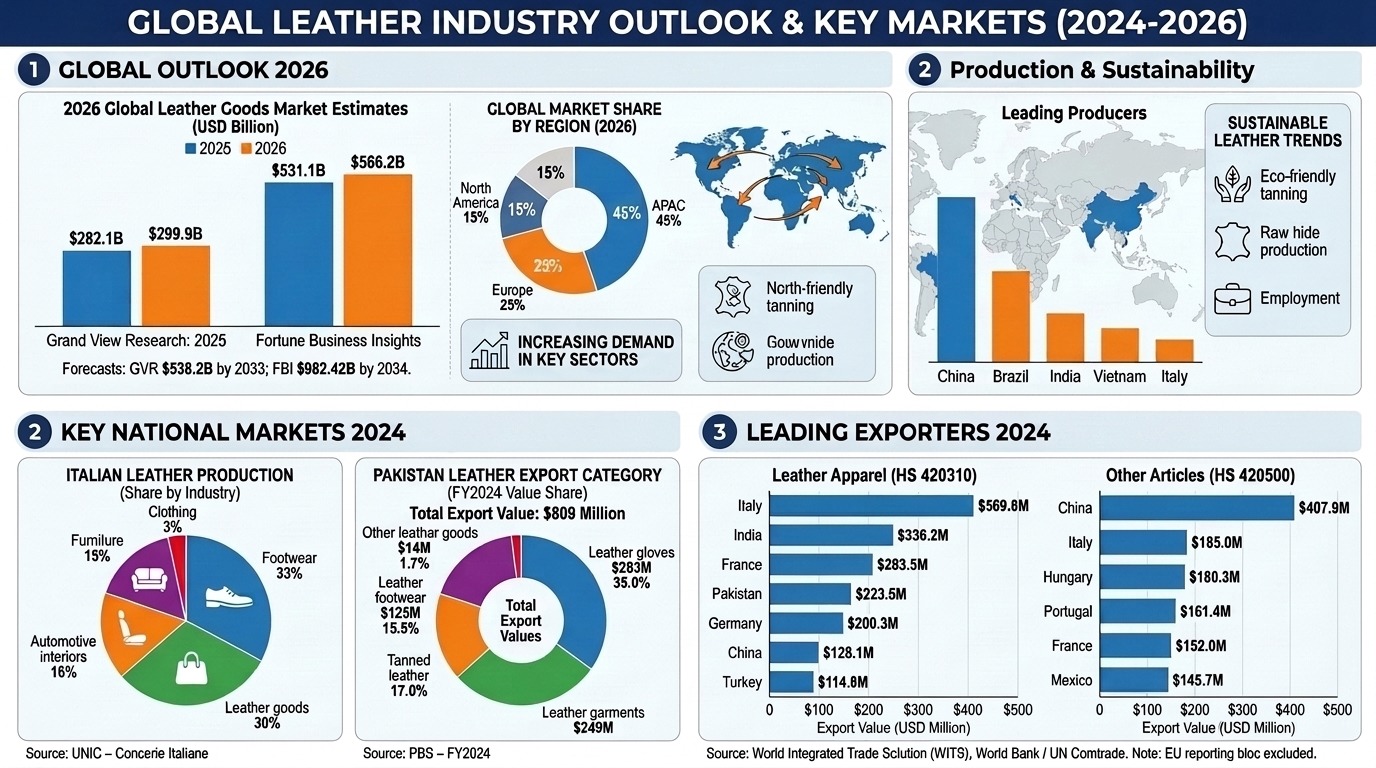
The global leather industry in 2026 spans a much larger value chain than leather jackets, handbags, and footwear. It begins with hides and skins, continues through tanning and finishing, and extends into footwear, bags, apparel, gloves, accessories, upholstery, and other finished goods.
That distinction matters when interpreting industry statistics. A figure describing the leather goods market is not the same as the value of leather traded internationally or the amount of leather physically produced. Even major research firms currently publish significantly different estimates because their definitions and methodologies vary.
This report separates those measurements wherever possible and uses the latest available data to examine the size, structure, and direction of the global leather industry.
Global Leather Industry in 2026: Key Statistics
Before looking at individual countries and manufacturers, these figures provide a useful snapshot of the industry’s scale.
| Indicator | Latest Figure | Reference Year |
| Global leather goods market estimate — Grand View Research | $299.9 billion | 2026 |
| Global leather goods market estimate — Fortune Business Insights | $566.23 billion | 2026 |
| Genuine leather share of the leather goods market — GVR | 52.7% | 2025 |
| Leather footwear share of the leather goods market — GVR | 37.3% | 2025 |
| Global footwear production | 23.9 billion pairs | 2024 |
| Asia’s share of global footwear production | 88% | 2024 |
| China’s share of global footwear production | Just over 54% | 2024 |
| Global footwear exports | 14.8 billion pairs | 2024 |
| Global footwear export value | Approx. $170 billion | 2024 |
Sources: Grand View Research, Fortune Business Insights, and World Footwear/APICCAPS. (Grand View Research)
There is an important qualification to this table: global footwear statistics include footwear made from materials other than leather. They are included because footwear is a major downstream market connected to the leather supply chain, but 23.9 billion pairs should not be interpreted as 23.9 billion pairs of leather footwear. World Footwear reports that Asia accounted for 88% of all footwear production in 2024, with China producing 13 billion pairs, India accounting for 12.5% of global output, and Vietnam 6.5%. (World Footwear)
How Big Is the Global Leather Industry in 2026?
There is no single universally accepted valuation for the global leather industry.
Current estimates for the narrower leather goods market vary substantially. Grand View Research estimates the market at $299.9 billion in 2026, up from $282.1 billion in 2025. Fortune Business Insights places its 2026 market at $566.23 billion, following an estimated $531.07 billion in 2025. (Grand View Research)
2026 Global Leather Goods Market Estimates
| Research Source | 2025 | 2026 | Forecast | Forecast CAGR |
| Grand View Research | $282.1B | $299.9B | $538.2B by 2033 | 8.7% |
| Fortune Business Insights | $531.07B | $566.23B | $982.42B by 2034 | 7.13% |
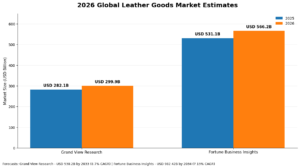
“2026 Global Leather Goods Market Size Estimates by Research Provider (USD Billion)”
The difference is too large to ignore. Fortune’s estimate is almost 89% higher than Grand View’s.
Rather than averaging the two figures and presenting the result as a global market value, the more accurate conclusion is:
Published estimates place the 2026 global leather goods market at roughly $300 billion to $566 billion, depending on the research provider and market definition.
Why Do Leather Market Estimates Differ So Much?
The main reason is scope.
Grand View Research divides its market by genuine and synthetic leather and includes handbags, small leather goods/accessories, apparel, footwear, pet accessories, and automotive accessories. Its genuine-leather segment represented 52.7% of 2025 revenue.
Fortune Business Insights also includes synthetic leather within its market definition, but uses different product segmentation: apparel, luggage, footwear, and others, and a different proprietary market-estimation methodology.
This means two reports carrying the label “leather goods market” may not be measuring precisely the same basket of products.
For this reason, this report distinguishes between:
- Market size estimates — estimated commercial value of the market.
- Production data — what countries physically produce.
- Export data — goods leaving a country.
- Import data — goods entering a country.
- Company data — manufacturers, suppliers, and buyers operating within the industry.
Which Region Leads the Global Leather Goods Market?
Even regional leadership depends on the dataset being used.
Grand View Research identifies Asia-Pacific as the largest regional leather goods market, accounting for 36.6% of global revenue in 2025, with China holding the largest share within Asia-Pacific. It also reports leather footwear as the largest product segment at 37.3% of market revenue.
Fortune Business Insights reaches a different conclusion. Its model places Europe first with 37.31% of the global market in 2025, attributing the region’s position partly to luxury demand, fashion, and tourism-related retail activity.
Regional Comparison
| Source | Leading Region | Share | Reference Year |
| Grand View Research | Asia-Pacific | 36.6% | 2025 |
| Fortune Business Insights | Europe | 37.31% | 2025 |
What Is Driving the Leather Industry in 2026?
Several forces are shaping the industry’s direction.
Grand View Research identifies premium and durable products, fashion demand, processing technology, and e-commerce expansion among the factors supporting leather-goods growth.
At the supply-chain level, the industry’s priorities are also changing. The 2026 APLF Leather Supply Chain Conference placed traceability, sustainable quality, verified data, AI, and digital twins for tannery operations directly on its agenda. APLF’s subsequent post-show report described sustainability, AI, and traceability as critical challenges shaping the industry’s future and emphasized the importance of reliable, verifiable data.
These developments suggest that the next phase of competition will not be based solely on price and manufacturing capacity. Product quality, traceability, production efficiency, reliable supplier data, and supply-chain transparency are becoming increasingly important across the global leather industry.
Leather Production, Exports, Imports & Global Buyers
The countries that produce the most leather are not necessarily the countries that export the most finished leather goods. A country may be a major source of hides, another may specialize in tanning, while another imports leather and converts it into jackets, bags, footwear, or gloves for export.
For that reason, production, exports, and imports need to be analyzed separately.
Which Countries Produce the Most Leather?
There is no reliable single ranking covering every stage of leather production under one metric.
The leather supply chain can be divided into:
- Raw hides and skins
- Tanned and finished leather
- Finished leather goods
- Leather footwear
- Leather apparel and accessories
China has enormous downstream manufacturing capacity, while countries including Brazil and India have large raw-material bases. Italy holds a major position in tanning and high-value finished leather, while Pakistan is particularly important in leather apparel and gloves.
This distinction is important when someone asks, “Who is the world’s largest producer of leather?” The answer changes depending on whether production means raw hides, finished leather, or manufactured leather products.
A detailed ranking of the top leather-producing and exporting countries worldwide should therefore compare countries using the same production and trade classifications rather than combining unrelated measurements.
How Leather-Producing Countries Differ
| Country | Major Position in the Supply Chain |
| China | Large-scale leather goods and footwear manufacturing |
| India | Hides/skins, tanning, footwear, apparel, and leather goods |
| Brazil | Major cattle/hide base and tanning industry |
| Italy | High-value tanning, finished leather, and luxury manufacturing |
| Pakistan | Leather apparel, gloves, footwear, and finished leather |
| Turkey | Leather apparel, footwear, and finished goods |
| Vietnam | Large footwear and leather-goods manufacturing base |
Top Leather Exporting Countries: Why the HS Code Matters
International trade data gives us a more objective way to compare countries, but only after defining what is being exported.
For example:
- HS 41 covers raw hides, skins, and leather.
- HS 42 covers articles of leather and related goods.
- HS 4202 includes luggage, handbags, and similar containers, but not every product under the heading is necessarily leather.
- HS 4203 covers leather apparel and clothing accessories.
- HS 64 covers footwear, including both leather and non-leather products.
This means a ranking for “leather exporters” can change significantly depending on the HS classification being measured.
Leather Apparel Shows a Very Different Export Map
Major Exporters of Leather Apparel in 2024 HS 420310 (USD Million)
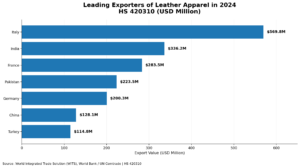
The European Union, as a reporting bloc, recorded about $667.1 million, but it should not be ranked as a country alongside individual EU members. (World Integrated Trade Solution)
For businesses evaluating production locations, these differences are one reason sourcing leather products from China, Pakistan, India, and Turkey should be considered at the product-category level rather than assuming one country is strongest across the entire leather industry.
Finished Leather Articles Tell Another Story
Changing the product classification changes the leaders again.
For HS 420500, other articles of leather or composition leather, World Bank WITS/UN Comtrade reports China as the largest individual-country exporter in 2024 at approximately $407.9 million.
Leading exporters of other articles of leather in 2024 under HS 420500, led by China, Italy, Hungary, Portugal, France and Mexico.
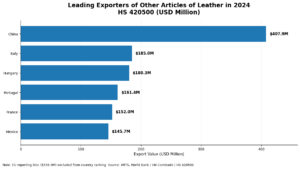
This gives us an important conclusion for the overall report:
There is no defensible single list of the “top leather exporting countries” without first defining the leather product category being measured.
Top Leather Importers: Where Is the Demand?
Imports show the other side of the global leather industry: where products are being bought rather than where they are being manufactured.
This section requires the same classification discipline.
A country importing large quantities of raw hides is participating in a different part of the industry from a country importing finished handbags or leather jackets.
1. Raw Material Buyers
Tanneries and processors importing:
- Raw hides
- Skins
- Semi-processed leather
2. Manufacturing Buyers
Factories importing finished or semi-finished leather to manufacture:
- Footwear
- Bags
- Jackets
- Gloves
- Furniture
- Automotive interiors
3. Finished-Goods Buyers
Retailers, brands, distributors, and wholesalers are importing completed leather products.
The United States and Europe as Leather Buyer Markets
The United States and European markets play particularly important roles as destinations for finished leather goods, while parts of Europe also have substantial tanning and manufacturing activity.
Europe, therefore, operates on both sides of the leather supply chain: importing raw materials while also producing and exporting high-value leather and finished goods.
This structure can be seen in the European tanning sector. Reuters reported in 2026 that European tanneries source around 40% of their raw materials from abroad, including countries such as Brazil and the United States.
That makes the distinction between a leather-producing country, a manufacturing country, and a buying country particularly important. The same country can occupy several positions in the supply chain simultaneously.
Pakistan’s Export Position Is Product-Specific
Pakistan provides another useful example.
It would be inaccurate simply to describe Pakistan as either a “major leather exporter” or a “minor leather exporter” without specifying the product.
Under HS 420310, Pakistan exported approximately $223.5 million of leather apparel in 2024, placing it behind Italy, India, and France among individual countries in the WITS dataset but ahead of China and Turkey by export value in that specific classification.
By contrast, under the much narrower HS 420500 category, Pakistan recorded only about $525,000 in exports during 2024.
The difference demonstrates why Pakistan’s leather industry is better analyzed by individual categories; finished leather, garments, gloves, footwear, bags, and other products; rather than represented by one isolated trade number.
What the Trade Data Tells Buyers
For brands and B2B buyers, the main lesson is straightforward: choose manufacturing countries according to the product you need.
A country with a large tanning industry isn’t automatically the strongest location for leather bags. Likewise, a major footwear exporter may not be the best source for leather jackets or gloves.
Before selecting a production market, buyers should compare:
- Product specialization
- Export history
- Manufacturing capacity
- Leather availability
- Quality requirements
- MOQ
- Labor and production costs
- Logistics
- Compliance requirements
Major Leather Manufacturing Countries & Global Leather Hubs
Leather manufacturing is distributed across several countries, but their roles are not identical. Some countries have enormous footwear and finished-goods capacity, others specialize in tanning, while others have developed strong export positions in specific products such as leather jackets, gloves, or luxury goods.
For buyers, asking which country makes the “best” leather products is therefore less useful than asking which manufacturing country is strongest for the product, quality level, and production model required.
Which Country Makes the Best Leather Products?
There is no single country that objectively produces the best leather products across every category.
Italy is strongly associated with high-value tanning and luxury production. China offers an enormous manufacturing scale. India has a diversified leather and footwear industry. Pakistan has substantial leather garment and glove exports. Turkey combines leather, apparel, and footwear manufacturing with proximity to European markets.
Major Leather Manufacturing Countries and Their Strengths
| Country | Major Strengths | Particularly Known For |
| China | Scale, supply-chain depth, manufacturing capacity | Footwear, bags, accessories, finished goods |
| India | Diversified leather industry and, large domestic manufacturing base | Footwear, leather goods, garments, saddlery |
| Italy | High-value tanning, finishing, design, and craftsmanship | Luxury leather, footwear, bags |
| Pakistan | Export-oriented value-added manufacturing | Leather gloves, jackets, garments, and footwear |
| Turkey | Manufacturing + access to European markets | Footwear, apparel, leather goods |
| Vietnam | Large export-oriented manufacturing base | Footwear, bags, and accessories |
| Brazil | Large cattle/raw-material base | Hides and leather processing |
This is a specialization overview rather than a ranking. “Best” depends on specifications, tannage, craftsmanship, factory capability, quality control, MOQ, compliance, and price.
China: Scale and Manufacturing Infrastructure
China remains difficult to match when manufacturing scale is the primary consideration.
Its dominance is particularly visible in footwear. APICCAPS reported that China produced approximately 13 billion pairs of footwear in 2024, accounting for just over 54% of global footwear production. Asia as a whole produced 88% of the world’s footwear. These figures include both leather and non-leather footwear, so they should not be interpreted as leather-only production statistics.
China’s advantage extends beyond production volume. Its mature manufacturing ecosystem gives brands access to component suppliers, hardware, packaging, machinery, logistics, and large-scale factories within established industrial networks.
This makes China particularly competitive, where production volume, supply-chain integration, and manufacturing flexibility are major considerations.
However, scale does not automatically make China the best sourcing location for every leather category. As Part 2 showed, Italy, India, and Pakistan all outranked China by export value in the specific HS 420310 leather apparel category in 2024.
That is why country comparisons should be made product by product rather than using overall manufacturing size as the deciding factor.
India: A Diversified Leather and Footwear Industry
India occupies a different position because its leather ecosystem extends from raw materials and tanning through to finished products and footwear.
According to India’s Council for Leather Exports, footwear accounted for approximately 51% of the country’s leather and footwear industry exports in 2024–25. Leather goods and accessories, including saddlery and harness products, represented approximately 31%, while leather garments accounted for about 7%.
The same official industry overview identifies India as the second-largest global exporter of leather garments and the fifth-largest exporter of leather goods and accessories.
India’s export portfolio for 2024–25 included approximately $445.3 million of finished leather, alongside much larger exports from finished-product categories.
This diversified structure makes India relevant for brands sourcing footwear, bags, leather goods, apparel, and other manufactured products rather than a single narrow category.
Pakistan: Strong in Leather Gloves and Garments
Pakistan’s position becomes much clearer when its leather exports are broken down by product.
According to the Pakistan Bureau of Statistics, leather and leather-product exports totaled approximately $809 million in FY2024. The composition was particularly revealing:
| Pakistan Leather Export Category | FY2024 Export Value | Share |
| Leather gloves | $283M | 35.0% |
| Leather garments | $249M | 30.8% |
| Tanned leather | $138M | 17.0% |
| Leather footwear | $125M | 15.5% |
| Other leather goods | $14M | 1.7% |
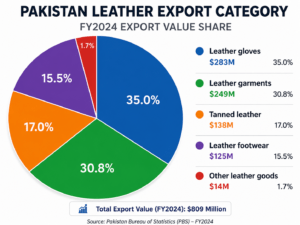
Note: Category values and shares may not sum exactly to the reported total because of rounding.
Pakistan Bureau of Statistics reports that total leather and leather-product exports declined 8.9% in FY2024, but leather gloves still reached $283 million and represented the country’s largest leather export category.
This tells us something more useful than simply calling Pakistan a “leather-producing country.”
Pakistan has a particularly strong position in value-added leather manufacturing, especially gloves and garments. Together, those two categories accounted for roughly two-thirds of the leather export portfolio reported by PBS for FY2024. (Pakistan Bureau of Statistics)
European and North American markets were important destinations for Pakistan’s leather garments and gloves, while Vietnam was the largest destination for its tanned leather exports in FY2024.
Pakistan’s performance is better understood through category-level export data covering garments, gloves, footwear, bags, and finished leather.
Italy: High-Value Tanning and Luxury Leather
Italy’s importance cannot be measured by production volume alone.
According to UNIC – Italian Tanneries, the Italian tanning industry includes 877 companies employing more than 17,000 people, with an annual turnover exceeding €4 billion. Approximately 67% of turnover is generated through exports to around 117 countries. (UNIC – Concerie Italiane)
Selected downstream industries served by Italian leather production :
| Customer Industry | Share of Italian Leather Production |
| Footwear | 33% |
| Leather goods | 30% |
| Automotive interiors | 16% |
| Furniture | 15% |
| Clothing | 3% |
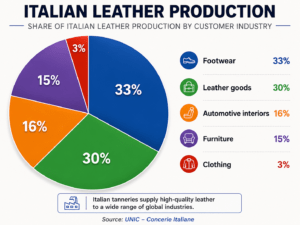
Note: Figures shown represent the categories reported in the source and may not constitute the complete distribution.(UNIC – Concerie Italiane)
This helps explain Italy’s position in global leather manufacturing. Its competitive advantage is concentrated around tanning expertise, finishing, quality, design, specialization, and high-value manufacturing, rather than competing purely on factory volume.
Italy’s leather industry is also geographically clustered, which brings us to another important feature of global leather manufacturing.
Major Leather Manufacturing Cities and Clusters
Leather industries often develop as geographic clusters rather than being evenly distributed across an entire country.
These clusters bring together tanneries, manufacturers, skilled labor, component suppliers, exporters, and supporting services.
Important Leather Manufacturing Hubs
Italy — Veneto, Tuscany, and Campania
Italy’s tanning industry is concentrated in three major districts. UNIC identifies the Tuscan district around Santa Croce sull’Arno and neighboring areas as an important center, while Campania includes the Solofra tanning hub.
India — Tamil Nadu, and other established leather clusters
India has multiple leather and footwear manufacturing centers rather than one dominant city. Tamil Nadu is particularly important, with continued investment in leather, footwear, and accessories infrastructure. India’s current development program includes a Mega Leather, Footwear & Accessories Cluster at Panapakkam in Ranipet District.
Pakistan — Sialkot and other manufacturing centers
Pakistan’s industry includes specialized manufacturing clusters, with Sialkot particularly associated with export manufacturing and leather gloves. Other parts of the country contribute to tanning, footwear, garments, and finished leather goods.
Turkey — Istanbul and established leather/footwear manufacturing regions
Turkey benefits from an established textile, apparel, footwear, and leather manufacturing ecosystem combined with geographic access to European markets.
China — Multiple specialized manufacturing clusters
China’s enormous manufacturing base is spread across multiple industrial regions specializing in footwear, bags, apparel, accessories, and related supply chains rather than one single “leather capital.”
China vs India vs Pakistan vs Turkey: Quick Comparison
These four countries are particularly relevant to brands evaluating international leather manufacturing.
| Factor | China | India | Pakistan | Turkey |
| Manufacturing scale | Very large | Large | Specialized | Established |
| Footwear | Major strength | Major strength | Export category | Major category |
| Leather garments | Active | Strong exporter | Major strength | Established |
| Leather gloves | Active | Active | Major export strength | Active |
| Bags/accessories | Large-scale | Strong | Developing/export-oriented | Established |
| Supply-chain depth | Extensive | Broad | Product-specialized | Broad |
| Geographic advantage | Asian/global supply chain | Raw material + manufacturing base | Export manufacturing | Close to EU |
A detailed China vs. Pakistan vs. India vs. Turkey comparison should examine export values, production economics, specialization, MOQs, lead times, and trade access.
For businesses currently deciding between these markets, the choice should ultimately be based on the specific product and supplier rather than country reputation alone. The economics and practical differences involved in sourcing leather products from major manufacturing countries become more relevant once product specifications, quantities, and quality requirements are defined.
Manufacturing Strength Does Not Equal Product Quality
One final distinction is important.
A country can be one of the world’s largest leather manufacturing centers without every factory in that country producing high-quality goods.
Product quality depends on factors such as:
- Hide selection and leather grade
- Tanning and finishing quality
- Pattern development
- Cutting accuracy
- Stitching
- Hardware
- Construction methods
- Quality-control systems
- Worker skill
- Manufacturer specialization
Likewise, a smaller manufacturer in Pakistan, India, Turkey or Italy may outperform a much larger factory elsewhere when producing a highly specialized product.
For B2B buyers, country-level statistics are therefore useful for identifying manufacturing ecosystems. The final supplier decision still needs to be made at the factory level.
That distinction becomes particularly important when we move from countries to the actual manufacturers, suppliers, and buyers operating within the global leather industry.
Leading Leather Manufacturers, Suppliers & Global Buyers
The global leather supply chain includes businesses performing very different functions. Tanneries convert hides into leather, finished-product manufacturers turn leather into goods, suppliers connect materials or products with buyers, and brands, retailers, wholesalers, and other manufacturers create international demand.
Major Leather Manufacturers Around the World
There is no authoritative global league table ranking leather manufacturers from #1 to #10 across every category.
A tannery producing millions of square feet of finished leather cannot be directly compared with a factory producing handbags or leather jackets. Instead, manufacturers should be evaluated within their segment using measurable factors such as production capacity, manufacturing footprint, export reach, specialization, and independently verifiable certifications.
Some established names illustrate the scale and diversity of this manufacturing network.
Examples of Major Leather Manufacturers
| Manufacturer | Main Manufacturing Presence | Specialization | Notable Position |
| PrimeAsia | China, Vietnam, Indonesia | Footwear & lifestyle leather | 150M+ sq. ft. annual capacity |
| Gruppo Mastrotto | International | Finished leather | Major international tanning group |
| JBS Couros | International | Bovine leather | Large global leather producer |
| KH Exports | India | Leather & leather products | Major Indian leather manufacturer |
| Adiantes | Thailand | Bags & small leather goods | OEM finished-goods manufacturer |
This is not a ranking of the five largest companies. It is a selection of established manufacturers representing different parts of the leather supply chain.
For example, PrimeAsia reports annual production capacity exceeding 150 million square feet, more than 3,200 employees, and manufacturing operations across major Asian footwear hubs.
The Leather Working Group’s current governing board also includes manufacturer representatives from JBS Couros, Gruppo Mastrotto, KH Exports India, and Industrias del Curtido, illustrating the international nature of large-scale leather production.
A broader comparison of leading leather manufacturers around the world is more useful when companies are grouped according to their manufacturing capabilities rather than placed into an arbitrary overall ranking.
Leather Manufacturer vs Finished-Goods Manufacturer
This distinction becomes especially important in B2B sourcing.
A leather manufacturer or tannery converts hides or semi-processed material into usable leather.
A leather goods manufacturer converts that material into products such as:
- Bags
- Jackets
- Gloves
- Footwear
- Wallets
- Belts
- Accessories
For example, PrimeAsia manufactures leather material primarily for the footwear and leather goods markets. By comparison, Thailand-based Adiantes operates as an OEM manufacturer producing handbags, totes, backpacks, wallets, and other small leather goods for international clients.
A brand looking for private-label handbags, therefore, requires a very different manufacturing partner from a footwear factory looking to purchase finished leather by the square foot.
Major Leather Supplier Types in the Global Market
“Leather supplier” is an even broader term.
A supplier might be:
A tannery selling finished leather.
A manufacturer supplying completed products.
A trader purchasing leather from manufacturers and reselling it.
An exporter managing international distribution.
A specialist supplier providing chemicals, machinery, components, or other inputs.
The Leather Working Group makes similar distinctions within its own ecosystem. Companies eligible for its audit standards include leather manufacturers, traders, subcontractors, and commissioning manufacturers, while its broader membership also includes brands, retailers, chemical and machinery suppliers, agents, and finished-product manufacturers. (Leather Working Group)
This is why buyers should understand the difference between a leather supplier, manufacturer, and trader before comparing quotations or manufacturing capabilities.
How Leather Suppliers Should Be Compared
Rather than ranking suppliers simply by company size, B2B buyers should evaluate:
| Factor | What to Check |
| Supplier type | Manufacturer, tannery, trader or exporter |
| Product specialization | Leather type or finished-product category |
| Production capability | Own factory or outsourced production |
| Capacity | Monthly/annual production capability |
| Markets served | Domestic vs international |
| MOQ | Minimum commercially viable order |
| Quality systems | Testing and QC procedures |
| Certification | Relevant verified certifications |
| Traceability | Origin and processing documentation |
| Samples | Consistency with bulk production |
| Export experience | Documentation and destination-market knowledge |
Certification can be a useful verification layer. Leather Working Group, for example, maintains a searchable database of certified leather suppliers that can be filtered by country, supplier, material, and tanning type. (Leather Working Group)
Certification alone, however, does not establish that a supplier is suitable for a specific product or order.
Who Buys Leather Globally?
The buyer side of the industry is equally fragmented.
Leather demand comes from several industries:
1. Footwear Companies
Footwear is one of the largest downstream users of leather. Brands and footwear manufacturers purchase finished leather for uppers, linings, and other components.
2. Fashion & Luxury Companies
Luxury and fashion companies source leather for handbags, small leather goods, footwear, apparel, and accessories.
Leather Working Group’s current membership illustrates the breadth of this buyer ecosystem, including companies and groups such as Adidas, Burberry, Chloé, IKEA, Inditex, LVMH, Marks & Spencer, and Nike. Membership should not be interpreted as a ranking of the world’s largest leather buyers, but it demonstrates how leather sourcing extends across footwear, fashion, luxury, furniture, and retail. (Leather Working Group)
3. Automotive Manufacturers and Suppliers
Leather is used in vehicle seating, steering wheels, trim, and interior applications. Automotive leather has its own technical specifications, durability requirements, and supply chains.
4. Furniture Manufacturers
Furniture and upholstery companies purchase leather according to different specifications than fashion brands, often requiring larger hides, consistent finishing, and performance characteristics.
5. Brands, Wholesalers & Retailers
Finished-goods manufacturers supply leather jackets, bags, gloves, belts, wallets, and other products to brands, wholesalers, and retailers.
These buyers may purchase directly from factories or work through sourcing companies, distributors, and trading businesses.
Leading Leather Buyers vs Largest Leather-Importing Countries
These two concepts should not be confused.
A top importing country is identified through customs trade value.
A leading leather buyer is an individual company purchasing leather or leather products.
The United States might therefore rank highly as a destination market while thousands of separate companies account for those imports.
Similarly, a global brand may source leather from multiple countries and then manufacture products somewhere else entirely.
For this global report, country-level import data provides a more reliable measure of international demand. Company-level rankings should only be published where comparable purchasing or shipment data is available.
Claims such as “Company X is the world’s largest leather buyer” should only be made when procurement volumes or equivalent evidence can substantiate them.
The Leather Supply Chain Is Becoming More Connected
It begins with hides and skins, continues through tanning and finishing, and extends into finished goods. Readers looking at the production process can also see how leather is made.
The traditional supply chain could be simplified as:
Hide → Tanner → Manufacturer → Importer → Brand/Retailer → Consumer
Modern sourcing is considerably more complex.
A brand may specify leather from an approved tannery in Italy, manufacture its bags in Spain, source hardware elsewhere in Europe or Asia, and sell the finished products globally.
The leather-goods manufacturing hub of Ubrique in Spain provides a current example. Vogue reported in July 2026 that the region manufactures leather goods for international brands, including Strathberry, DeMellier, and Polène, while brands may maintain preferred material suppliers outside the local production cluster. (Vogue)
Likewise, APLF reported in 2026 that brands and manufacturers attending its Hong Kong event were actively looking for better supply-chain partners as requirements expand beyond traditional leather into traceability, compliance, and alternative materials. (APLF Limited)
Supplier discovery is therefore increasingly about more than finding a company that can quote a price.
Buyers need to identify what the supplier actually does, where production takes place, what materials it works with, and whether its capabilities match the intended product.
From Supplier Discovery to a Dedicated Leather Marketplace
This fragmentation is also why general supplier directories can be difficult to use for specialized leather sourcing.
A business searching for a tannery producing specific finished leather has fundamentally different requirements from a brand looking for an OEM leather bag factory or an importer sourcing wholesale leather gloves.
A dedicated leather marketplace can organize that discovery around the leather industry itself, connecting buyers with manufacturers and suppliers across different product categories and manufacturing capabilities.
The value of such a system depends on the quality of supplier information available. Useful profiles should make distinctions such as:
Manufacturer or trader?
Raw material or finished goods?
OEM, private label or wholesale?
Products manufactured?
Markets served?
Production and export capabilities?
For example, manufacturer profiles on Tannorium can identify a business by manufacturing type, products, distribution model, and markets served rather than simply presenting a company name.
That becomes increasingly useful as international buyers diversify sourcing across China, India, Pakistan, Turkey, Southeast Asia, and established European manufacturing clusters.
What Buyers Should Verify Before Choosing a Manufacturer
Company size alone should never determine supplier selection.
A large tannery may be unsuitable for a small leather-goods brand, while a specialized factory may offer exactly the construction method, MOQ, and development capabilities that the brand requires. Buyers should therefore understand how to find reliable leather suppliers before comparing manufacturers.
Before placing an order, buyers should verify:
- Actual manufacturing location
- Whether production is owned or subcontracted
- Leather specifications
- Sample quality
- Production capacity
- MOQ
- Quality-control process
- Certifications where relevant
- Export experience
- Lead times
- References or track record
- Payment and commercial terms
The objective is not simply to find the largest supplier. It is to identify the manufacturer whose capabilities match the product being produced.
This becomes even clearer when the industry is examined product by product. Leather footwear, bags, jackets, and gloves have different manufacturing leaders, production hubs, supply chains, and export markets.
Major Leather Goods and Manufacturing Markets
The leather industry ultimately depends on demand for finished products. Footwear, handbags, jackets, gloves, wallets, belts, and other goods convert leather from an industrial material into products sold through B2B and consumer markets worldwide.
However, the size of these categories varies considerably. Available 2025 market research places footwear as the largest product segment within the leather goods market, accounting for 37.3% of revenue in Grand View Research’s model.
What Are the Best-Selling Leather Products?
There is no reliable global dataset that ranks every leather product by unit sales. Different reports also define the leather goods market differently.
Based on market size, international trade, and manufacturing activity, the major commercial categories include:
- Leather footwear — shoes, boots, formal footwear, and other categories.
- Leather bags & luggage — handbags, backpacks, briefcases, travel bags, and business bags.
- Leather apparel — jackets, coats, trousers, and other garments.
- Small leather goods — wallets, cardholders, cases, and similar accessories.
- Leather gloves — fashion, work, and protective applications.
- Belts & accessories — fashion and functional accessories.
- Automotive leather goods/accessories — interior-related applications.
- Specialist leather products — aprons, saddlery, protective products, and other industrial or work-related goods.
This should be treated as a list of major product categories rather than a precise worldwide sales ranking.
Leather Footwear: The Largest Product Segment
Footwear sits at the center of the global leather-products industry.
Grand View Research estimates the dedicated global leather footwear market at $168.4 billion in 2026, with Asia-Pacific accounting for 53.9% of the market in 2024. It forecasts the market reaching $229.2 billion by 2033.
This should not be confused with the much larger physical footwear-production numbers discussed earlier, which include shoes made from textiles, synthetics, rubber, and other materials.
Leather footwear manufacturing is particularly associated with large Asian manufacturing economies as well as established European production centers. Different countries compete on different factors: volume, price, technical capability, design, craftsmanship, and access to premium leather.
Top Leather Jacket Manufacturing Countries
Leather jackets fall within the broader leather-apparel trade rather than having a perfectly clean global customs category of their own.
For that reason, a “Top 10 leather jacket manufacturers by country” ranking would not be methodologically defensible
The 2024 HS 420310 leather-apparel data examined earlier provides a more defensible indication of where leather garment export strength exists. Italy led the category by export value, followed by India and France, with Pakistan also holding a substantial position.
Countries with Significant Leather Apparel Manufacturing
| Country | Industry Strength |
| Italy | Premium and luxury leather apparel |
| India | Large export-oriented leather garment industry |
| Pakistan | Jackets and other value-added leather garments |
| Turkey | Established leather apparel manufacturing |
| China | Large manufacturing ecosystem and finished goods capacity |
Individual factory quality still varies considerably within each country.
A leather jacket manufacturer needs capabilities extending beyond access to leather. Pattern development, grading, panel selection, cutting, stitching, lining installation, hardware, and finishing all affect the finished garment, which is why the leather jacket manufacturing process is more specialized than simply sewing leather panels together.
Top Leather Bag Manufacturing Countries
Leather bags form another major finished-goods category, but trade statistics require particular care.
HS 4202 covers trunks, suitcases, handbags, backpacks, and similar containers made from many different materials. Using the entire HS 4202 category as “leather bag exports” would therefore overstate leather trade.
A meaningful global leather bags trade analysis should isolate the appropriate leather-specific subheadings and compare export value, import value, leading exporting countries, leading importing countries, five-year changes, major destination markets, and product categories.
At the manufacturing level, leather bag production is distributed across both large Asian production centers and specialized European clusters.
Major Leather Bag Manufacturing Locations
| Country/Region | General Strength |
| China | Scale, broad supplier network, and component ecosystem |
| India | Leather-goods manufacturing and export capability |
| Italy | Premium/luxury leather goods and craftsmanship |
| Spain | Specialized leather-goods manufacturing clusters |
| Turkey | Bags, accessories, and regional manufacturing |
| Vietnam | Export-oriented bags and accessories manufacturing |
For brands, manufacturing location is only one consideration. Leather type, construction, hardware, MOQ, customization, and branding capabilities can be more important than country alone.
This is particularly relevant for private-label leather bags, where a brand may use an existing manufacturer while controlling leather selection, colors, branding, packaging, and product specifications.
Leather Gloves: A Major Export Category for Pakistan
Leather gloves demonstrate why product-level analysis can reveal strengths hidden by broad country rankings.
The Pakistan Bureau of Statistics reported approximately $283 million in leather-glove exports during FY2024, making gloves the largest category within Pakistan’s reported leather and leather-product export portfolio for that period.
Leather gloves themselves cover several markets:
Work and protective gloves
Used in construction, welding, industrial work, and other occupational applications.
Fashion gloves
Produced for apparel and luxury markets.
Specialized gloves
Designed for specific occupational or performance requirements.
International comparisons need to use the correct customs classification because glove subcategories differ.
For example, HS 420329 specifically covers certain protective leather/composition-leather gloves, mittens, and mitts for trades. It should not be treated as representing every leather glove sold worldwide. Pakistan’s strength in gloves demonstrates why product-level analysis can reveal manufacturing strengths that broad country rankings can obscure.
Other Important Leather Goods
Beyond footwear, bags, jackets, and gloves, the industry contains numerous commercially significant categories.
Wallets & Small Leather Goods
Wallets, cardholders, passport covers, organizers, and cases use relatively small amounts of leather but can command high retail values when material quality, craftsmanship, and branding are strong.
Leather Belts
Belts span luxury fashion, everyday apparel, workwear, and uniform markets and are manufactured across both large factories and small specialist workshops.
Leather Aprons
Leather aprons serve blacksmiths, welders, woodworkers, barbers, butchers, chefs, and other trades. Their market is much smaller than footwear or bags, but they illustrate how leather’s durability supports specialist applications.
Automotive & Upholstery Applications
Leather is also used across automotive interiors, furniture, and other upholstery applications where consistency, surface performance, and durability become particularly important.
What Is the Highest-Quality Leather?
Full-grain leather is generally considered the highest grade within the common grain-based classification because its natural grain surface has not been sanded away to remove imperfections.
That does not mean every product labelled “full-grain” is automatically high quality.
Quality also depends on:
- Hide selection
- Tanning
- Dyeing
- Finishing
- Thickness
- Fiber structure
- Cutting
- Product construction
A poorly tanned or badly constructed full-grain product can still perform worse than a well-made product using another appropriate leather.
The difference between full-grain and top-grain leather is therefore useful when evaluating material specifications, but grain terminology should never be used as the only measure of quality.
What Is the Most Expensive Leather?
There is no universal answer because leather prices vary according to species, grade, hide size, provenance, tannage, finish, availability, and regulatory restrictions.
Some exotic leathers can command substantially higher prices than conventional bovine, sheep, or goat leather because of limited supply, specialized processing, and luxury demand.
However, expensive does not automatically mean better.
For a leather work bag, jacket, or pair of boots, a suitable high-quality bovine, goatskin, or sheepskin leather may outperform a more expensive material depending on the required durability, weight, flexibility, and appearance.
Leather Brands vs Leather Manufacturers
This distinction is particularly important:
| Leather Brand | Leather Manufacturer |
| Markets products to consumers | Physically manufactures material/products |
| Owns brand identity | Operates manufacturing capabilities |
| May outsource production | May manufacture for multiple brands |
| Controls design/positioning | Controls production processes |
| May own some factories | May have no consumer-facing brand |
A luxury brand can therefore be globally famous for leather goods without being one of the world’s largest leather manufacturers.
Likewise, a factory producing hundreds of thousands of bags, jackets, or gloves for other businesses may be almost unknown to consumers.
For the global leather industry, both sides matter: brands create demand and market value, while manufacturers, tanneries, and suppliers provide the production infrastructure behind the finished products.
This distinction will become even more important as traceability, sustainability requirements, technology, and international sourcing reshape how those products move from hide to consumer.
The Future of the Global Leather Industry
The future of the global leather industry will be shaped by more than market growth. Traceability requirements, environmental performance, manufacturing technology, changing sourcing strategies, and greater supply-chain transparency are increasingly influencing how leather is produced, purchased, and sold.
For manufacturers and buyers, the competitive advantage is gradually shifting from simply producing at the lowest cost toward producing the right product with consistent quality, documented sourcing, and reliable manufacturing capabilities.
Sustainability and Traceability Are Reshaping Leather
Sustainability has become one of the industry’s most important long-term issues, but it should not be reduced to a simple comparison between “sustainable” and “unsustainable” materials.
Leather production involves several environmental and operational considerations, including:
- Chemical management
- Water and energy consumption
- Wastewater treatment
- Hide traceability
- Waste reduction
- Manufacturing efficiency
- Product durability
- Responsible sourcing
Traceability is becoming particularly important because brands increasingly need better visibility into where hides originate and how leather moves through the supply chain.
The 2026 APLF Leather Supply Chain Conference placed traceability, sustainable quality, and reliable data among its central topics, showing how these issues are moving deeper into commercial leather sourcing and manufacturing.
For buyers, sustainability claims therefore need to be supported by evidence rather than marketing terminology alone. The broader sustainability practices used across the leather industry also vary considerably by tannery, manufacturing process, and supply chain.
Technology Is Changing Leather Manufacturing
Leather manufacturing remains dependent on skilled craftsmanship, but modern factories increasingly combine traditional knowledge with digital production systems.
Important technologies include:
Computerized Cutting
Digital cutting systems can improve material utilization and cutting consistency, particularly where natural variations in hides need to be considered.
Digital Product Development
CAD systems, digital patterns, and product visualization can reduce development errors and improve communication between brands and factories.
Production Automation
Automation can improve consistency in repetitive manufacturing operations while allowing skilled workers to concentrate on processes requiring greater judgment.
AI and Digital Twins
Artificial intelligence is beginning to enter industrial leather discussions as well. APLF’s 2026 Leather Supply Chain Conference specifically included the use of AI and digital twins in tannery operations among its program topics.
Digital Supplier Discovery
The sourcing process itself is also changing. Buyers no longer need to depend entirely on trade shows, sourcing agents,and personal networks to identify international manufacturing partners.
Digital platforms can make supplier discovery easier, but the quality of supplier information remains critical. A directory containing thousands of poorly classified companies is less useful than a system that distinguishes manufacturers, suppliers, traders, products, and manufacturing capabilities.
This is one of the problems a dedicated leather marketplace can address by organizing sourcing specifically around the leather industry.
Global Leather Industry Outlook: 2027–2030
Current market-research forecasts generally expect continued growth in leather goods, although the projected growth rate varies substantially by research provider.
Rather than treating one forecast as certain, the more useful question is what structural changes are likely to influence the industry through 2030.
| Industry Trend | Current Direction | Potential 2027–2030 Impact |
| Traceability | Increasing | Greater documentation across supply chains |
| Environmental compliance | Increasing | More investment in tanning and processing |
| Digital sourcing | Expanding | Easier international manufacturer discovery |
| Manufacturing automation | Increasing | Improved efficiency and consistency |
| E-commerce | Expanding | Broader international access to leather goods |
| Supply-chain diversification | Continuing | Buyers sourcing across multiple countries |
| Data transparency | Increasing importance | Better supplier and product verification |
| Premium positioning | Product dependent | Continued opportunities for durable, higher-value goods |
These are directional industry observations rather than guaranteed forecasts.
What Does This Mean for Leather Manufacturers?
Manufacturers increasingly compete on more than price.
Factories that can demonstrate consistent production, material knowledge, quality control, traceability, and reliable communication may be better positioned to work with international brands.
Manufacturers should therefore focus on:
- Clear product specialization
- Documented manufacturing capabilities
- Strong quality-control systems
- Accurate material specifications
- Traceability where required
- International compliance
- Professional sampling
- Reliable lead times
- Transparent business information
Digital visibility will also matter. A capable manufacturer that international buyers cannot discover or properly evaluate may lose opportunities to competitors with stronger online visibility and clearer documentation.
What Does This Mean for Leather Buyers and Brands?
For buyers, the expanding number of sourcing options creates both opportunity and risk.
Selecting a manufacturer solely because it offers the lowest quotation can result in inconsistent materials, construction problems, delays, or products that do not meet the required specification.
A stronger sourcing process starts with defining:
Product → Material → Specification → Quantity → Target cost → Quality requirements → Manufacturing country → Supplier
rather than:
Country → Cheapest supplier.
Brands should also verify the actual factory behind production. The process of verifying a leather manufacturer before placing an order becomes especially important when sourcing internationally.
Manufacturing economics also needs to be evaluated beyond the quoted unit price. Leather selection, hardware, labor, MOQ, packaging, customization, shipping, and duties can all influence the final cost of manufacturing leather products.
A More Connected Global Leather Industry
The data throughout this report shows that there is no single center of the leather industry.
China has an extraordinary manufacturing scale. India combines leather production with significant finished-product manufacturing. Pakistan has established strengths in gloves and leather garments. Italy remains important in high-value tanning and premium leather production. Turkey, Vietnam, Brazil, and other countries occupy their own positions within the global supply chain.
At the same time, major consumer markets, international brands, and manufacturers depend on increasingly interconnected sourcing networks.
The industry is therefore better understood as a global ecosystem connecting:
Hides → Tanneries → Leather Manufacturers → Product Factories → Suppliers → Importers → Brands → Retailers → Consumers
The next stage of its development will depend partly on how efficiently information moves through that ecosystem alongside the physical products.
Research Methodology
The statistics in this report have been deliberately separated according to what they measure.
Market Size
Commercial market-research estimates were used to examine the estimated value and projected growth of leather goods markets.
Because providers use different market definitions and methodologies, their figures have been presented independently rather than averaged into a single artificial market value.
International Trade
Trade statistics should be analyzed using internationally recognized HS classifications.
Relevant classifications include:
- HS 41 — raw hides, skins, and leather
- HS 42 — articles of leather and related goods
- HS 4202 — luggage, handbags, and similar containers
- HS 4203 — leather apparel and clothing accessories
- HS 64 — footwear
Subheadings should be used whenever a broader HS heading includes non-leather products.
Production
Physical production statistics should be kept separate from trade values. Production volume, export value, and market size measure fundamentally different things.
Company Research
Manufacturers and suppliers should be evaluated using publicly verifiable information such as manufacturing facilities, production capabilities, export activity, certifications, specialization, and markets served.
Company size or brand recognition alone does not establish manufacturing quality.
Important Data Limitation
The most important methodological principle of this report is:
Market size, leather production, export value, import value, and company revenue are different measurements and should not be treated as interchangeable indicators of industry size.
Likewise, the latest complete trade dataset may be from 2024 or 2025 even though this report is published in 2026. Each statistic should therefore retain its reference year.
The Global Leather Industry Beyond 2026
The leather industry remains geographically diverse and commercially significant, but its structure is evolving.
Manufacturing scale will remain important, while traceability, quality assurance, environmental performance, technology, and supplier transparency are likely to become increasingly relevant to international sourcing decisions.
FAQs
Which country has the largest leather industry?
There is no single ranking because leather-industry size can be measured through hide production, tanning, finished-goods manufacturing, exports, or market consumption. China has enormous finished-goods and footwear manufacturing capacity, while countries including Italy, India, Pakistan, and Brazil hold important positions in specific parts of the leather supply chain.
Who is the world’s largest producer of leather?
The answer depends on what is being measured. Raw hide production, finished leather production, and leather-goods manufacturing are separate categories. China is a dominant finished-goods manufacturing economy, while other countries have significant positions in raw materials and tanning.
Which countries produce the most leather?
China, India, Brazil, Italy, and other major leather economies play significant roles, but their strengths differ between raw materials, tanning, and finished-goods manufacturing. A reliable ranking should therefore specify the production metric being compared.
What are the top leather-exporting countries?
The ranking changes according to product classification. For example, 2024 trade data for HS 420310 leather apparel placed Italy, India, France, and Pakistan among the leading individual-country exporters by value. Rankings for finished leather, bags, footwear, or other leather products can be different.
Which countries import the most leather?
Major import markets vary according to whether the product is raw hides, finished leather, or manufactured leather goods. The United States and European markets are particularly important destinations for many finished leather products, while manufacturing economies also import raw and finished leather for further processing.
Which country makes the best leather products?
No country is universally the best. Italy is known for premium tanning and luxury craftsmanship, China for manufacturing scale, India for its diversified leather and footwear sector, Pakistan for leather garments and gloves, and Turkey for established leather goods, apparel, and footwear manufacturing.
Which city is famous for leather?
Several cities and industrial clusters are internationally associated with leather. Examples include Santa Croce sull’Arno in Italy, leather and footwear clusters in Tamil Nadu, India, Sialkot in Pakistan, and established manufacturing regions in Turkey and China.
What is the highest-quality leather?
Full-grain leather is generally considered the highest grade within common grain-based classifications because its natural grain surface remains intact. However, tanning quality, hide selection, finishing, and product construction also determine the quality of the finished product.
What are the best-selling leather products?
Footwear is one of the largest leather-goods categories, followed by major markets for bags and luggage, apparel, small leather goods, belts, and gloves. Exact rankings depend on whether sales value, units, or international trade is being measured.
What Are the Top Leather Brands in the World?
Luxury houses, specialist leather-goods companies, footwear brands, and mass-market manufacturers operate very different businesses. There is no authoritative global ranking that determines which company makes the objectively “best” leather products.
Several globally recognized luxury houses are particularly associated with leather goods, including Hermès, Louis Vuitton, Gucci, Prada, Bottega Veneta, and Coach.
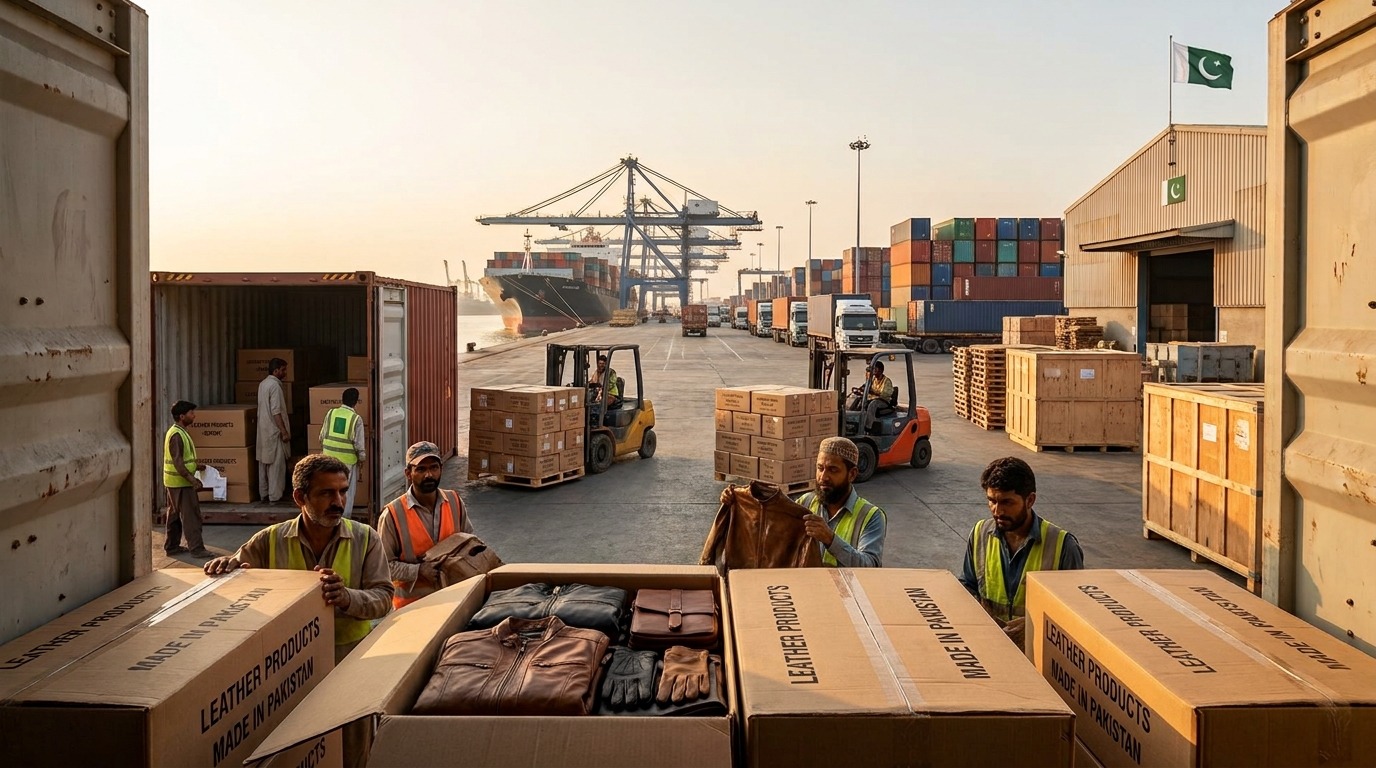
Pakistan Leather Industry Statistics 2026: Exports, Products & Trade

Pakistan leather industry statistics show that Pakistan exported $848.26 million in leather and leather products during FY202...
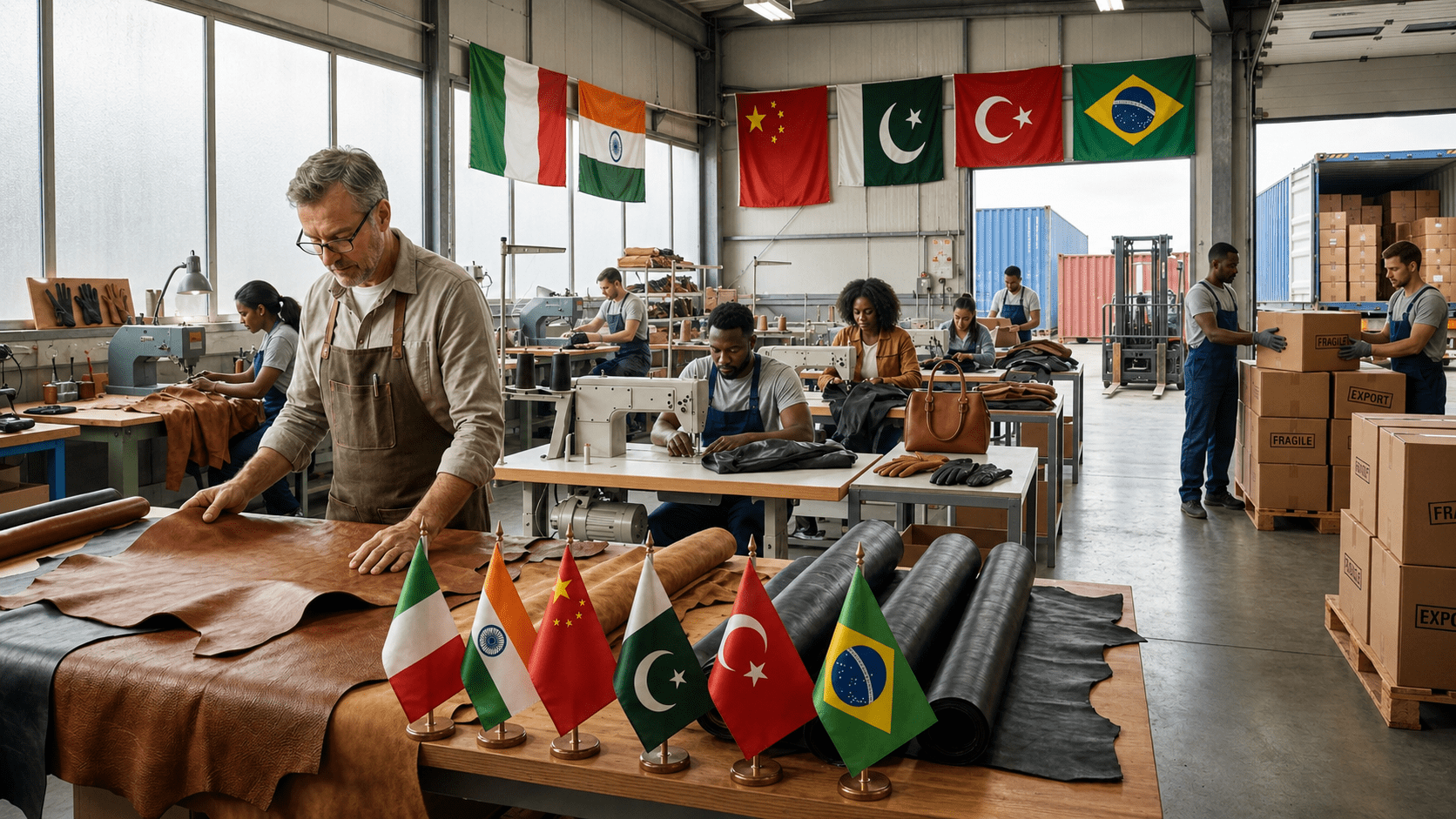
Top Leather Producing & Exporting Countries in 2026
The top leather producing & exporting countries are not necessarily the same. Production depends largely on the supply of...
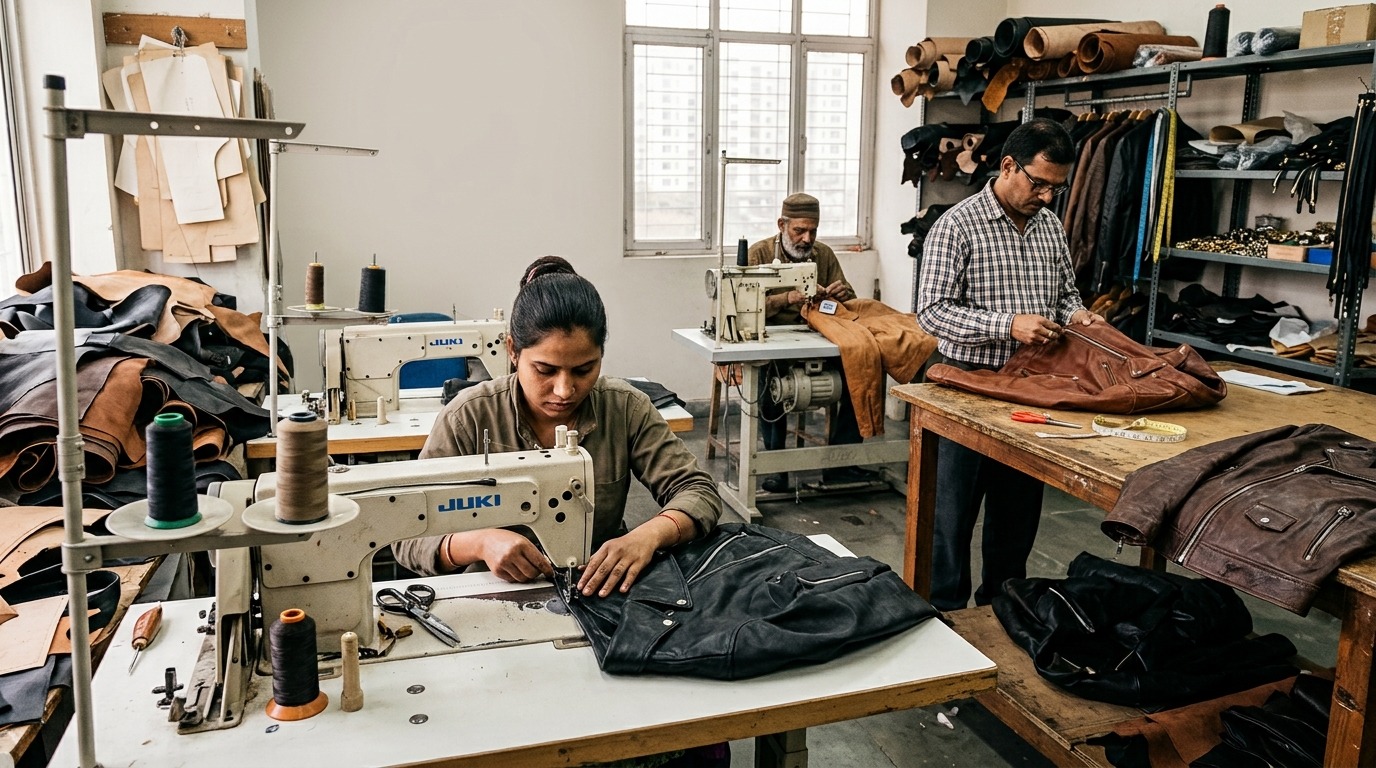
Private Label Leather Jackets: Everything You Need to Know
Private label leather jackets are manufactured by a third-party factory and sold under your own brand name, labels, packaging...