


Leather MOQ Explained: Everything Buyers Need to Know

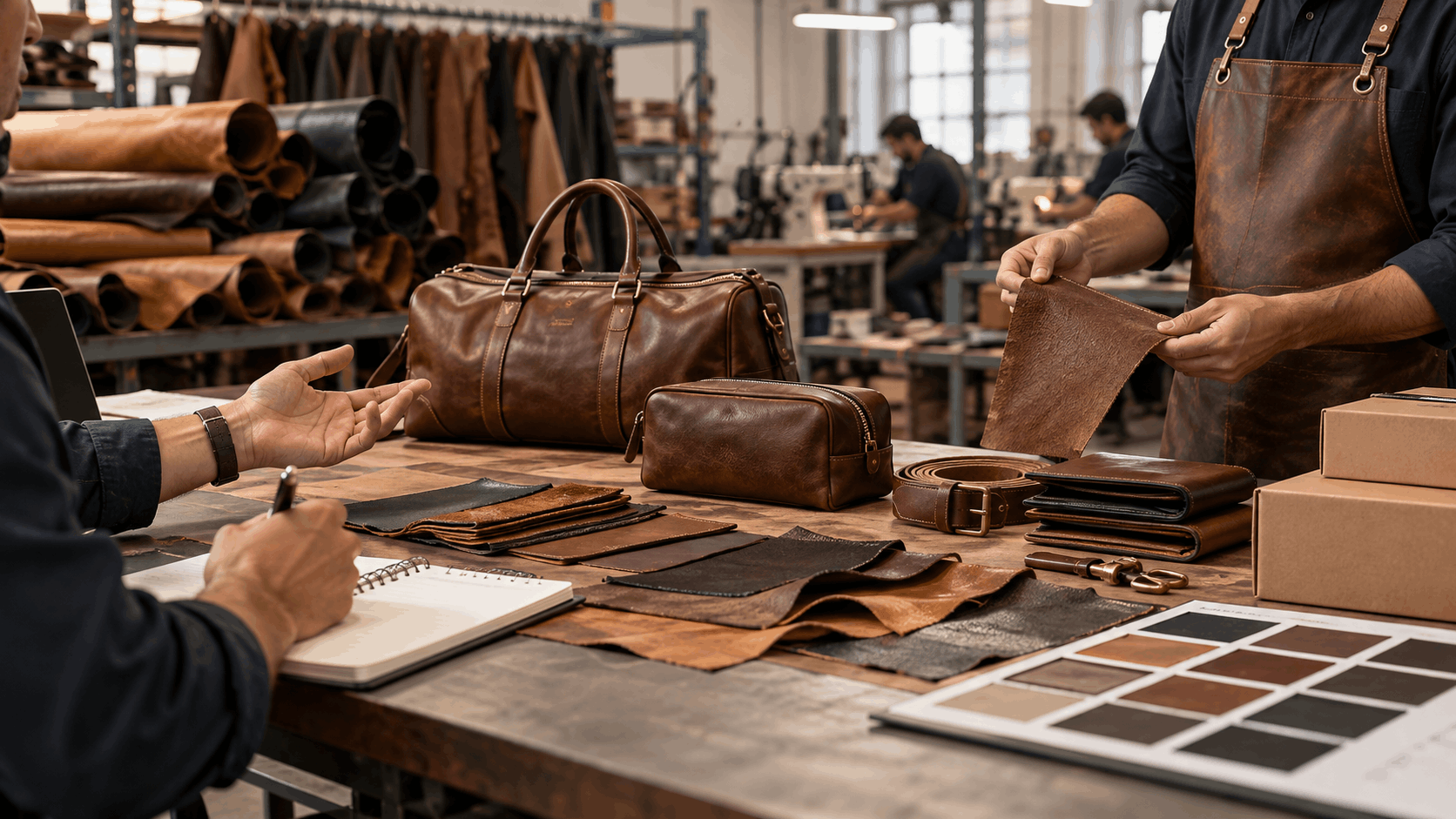
MOQ, or Minimum Order Quantity, is the smallest quantity of a leather product a manufacturer is willing to produce or sell in a single order. Understanding MOQ is important when sourcing leather products because it directly affects your inventory, upfront investment, product testing, and overall production costs.
For brands, wholesalers, startups, and first-time buyers, MOQ can vary considerably from one manufacturer to another. It may depend on the product, leather type, customization, colors, packaging, and production requirements. Before placing an order, buyers should understand exactly what a manufacturer’s MOQ includes.
Quick Answer: What Is MOQ in Leather Manufacturing?
MOQ (Minimum Order Quantity) is the smallest quantity of a leather product or manufacturing order that a supplier is willing to produce or sell in one order.
Manufacturers set MOQs to make production financially practical. Material purchasing, labor, cutting, machinery setup, custom components, packaging, and other production costs can make very small orders less efficient.
Why Do Leather Manufacturers Have MOQs?
Leather manufacturers typically set MOQs because every production order involves fixed costs and preparation work. These may include:
- Material purchasing: Manufacturers may need to purchase leather, lining, thread, or other materials in specific quantities.
- Production setup: Cutting patterns, preparing machinery, and organizing production require time and labor.
- Custom components: Custom hardware, labels, packaging, and other components may have their own minimum quantities.
- Economies of scale: Producing more units usually allows fixed production costs to be distributed across a larger order.
As a result, a manufacturer may not be able to offer the same pricing or production terms for a small order as for a larger one.
What Determines a Leather Manufacturer’s MOQ?
There is no universal MOQ for leather manufacturing. The required quantity can change based on several factors.
Product Type
Different leather products require different amounts of labor, materials, and production time. A simple existing product may have a lower MOQ than a complex custom design.
Leather Type and Material
The availability and sourcing requirements of the leather can affect MOQ. Specialty or less readily available materials may require manufacturers to purchase larger quantities.
If you are unfamiliar with leather terminology and material differences, our leather explained resource can provide useful background.
Customization
Custom colors, patterns, logos, hardware, dimensions, and construction details can increase the production requirements and, consequently, the MOQ.
Product Color
Some manufacturers establish a separate MOQ for each color because different colors may require separate material purchases or production batches.
Custom Packaging and Branding
Private-label products may require custom labels, boxes, bags, inserts, or other packaging. These components can have their own minimum order quantities.
Manufacturing Setup
Complex designs can require additional pattern development, tooling, machine setup, or production preparation, which can make small orders less practical.
Different Types of Leather MOQs Buyers Should Know
MOQ does not always refer to the total number of products. Manufacturers may apply different minimums to different parts of an order.
| MOQ Type | What It Means |
| Product MOQ | Minimum number of finished products required |
| Style/Design MOQ | Minimum quantity required for each design |
| Color MOQ | Minimum quantity required for each color |
| Material MOQ | Minimum quantity of leather or another material that must be purchased |
| Customization MOQ | Minimum quantity required for specific custom features |
| Packaging MOQ | Minimum quantity required for custom-branded packaging |
For example, if a manufacturer states “MOQ: 100 pieces,” that does not necessarily mean you can order 20 pieces in five different colors. The manufacturer may require 100 pieces per color or per design. Always confirm how the MOQ is calculated.
What Is a Typical MOQ for Leather Products?
There is no single standard MOQ for all leather manufacturers. MOQ depends on the manufacturer’s production model, product type, materials, customization, and order requirements.
| Product/Order Type | MOQ Can Depend On |
| Standard leather products | Existing design and available materials |
| Custom leather products | Design complexity and production requirements |
| Private-label products | Branding and packaging |
| Multiple colors | MOQ requirements per color |
| Custom leather/material | Material availability and sourcing |
| Small-batch orders | Manufacturer’s production model |
The most useful question is therefore not simply, “What is your MOQ?” Instead, ask whether the MOQ applies per product, design, color, material, or total order.
MOQ vs. Sample Order: What Is the Difference?
A sample and an MOQ serve different purposes.
A sample is produced so the buyer can evaluate the product’s design, materials, workmanship, and quality before committing to bulk production. The MOQ applies to the production order, not necessarily to the sample.
Sample costs are usually handled separately, so buyers should confirm whether the sample fee is refundable or can be credited toward a future bulk order.
Can You Negotiate a Lower MOQ?
Yes, sometimes. Whether a manufacturer can reduce its MOQ depends on its production setup and the requirements of the order.
You may have a better chance of negotiating a lower MOQ by:
- Choosing an existing manufacturer design
- Using available leather colors and materials
- Selecting standard hardware
- Reducing customization
- Using standard packaging
- Combining quantities where the manufacturer permits it
- Discussing a larger repeat-order commitment
However, a lower MOQ may come with a higher per-unit price because the manufacturer has fewer units over which to spread its setup and production costs.
What Happens If You Cannot Meet the Manufacturer’s MOQ?
If your required quantity is below the manufacturer’s MOQ, you still have several options.
You can ask whether the manufacturer offers a smaller trial order, request a sample first, simplify the product specifications, reduce the number of colors or designs, or look for a manufacturer that specializes in small-batch production.
It is also worth comparing the economics. Paying more per unit for a smaller order may be preferable to purchasing excess inventory that your business may not be able to sell.
Questions to Ask a Leather Manufacturer About MOQ
Before placing an order, ask the manufacturer:
- What is your MOQ per product?
- Is the MOQ per design or for the total order?
- Is there a separate MOQ for each color?
- Does custom branding change the MOQ?
- Does custom packaging have a separate MOQ?
- Can I place a smaller trial order?
- Is the sample included in the MOQ?
- Does the MOQ change for repeat orders?
- Will a lower MOQ increase the unit price?
- Can different products or colors be combined to meet the MOQ?
Getting these details in writing can prevent misunderstandings later in the production process.
How to Calculate Whether an MOQ Works for Your Business
MOQ should be evaluated alongside your total order cost and expected inventory requirements.
A simple calculation is:
Total Order Cost = Unit Price × Quantity + Customization + Packaging + Shipping + Applicable Import Costs
For example, ordering 500 units at a lower unit price may appear cheaper than ordering 100 units at a higher price per unit. But if you cannot sell the additional 400 units quickly, the larger MOQ may tie up more cash in inventory.
The right MOQ is therefore the quantity your business can realistically sell while maintaining acceptable product quality, margins, and cash flow.
Red Flags When Reviewing a Manufacturer’s MOQ
Be cautious if a manufacturer:
- Gives unclear or changing MOQ terms
- Introduces unexpected setup or customization charges
- Adds separate MOQs for colors or materials without explaining them
- Pressures you to place a large order before approving a sample
- Refuses to provide production terms in writing
A clear manufacturer should be able to explain exactly how its MOQ is calculated and what is included.
Leather MOQ Checklist for Buyers
Before confirming your order, make sure you have clarified:
- MOQ per product
- MOQ per design
- MOQ per color
- Customization MOQ
- Packaging MOQ
- Sample terms
- Unit price at your required quantity
- Lead time
- Shipping terms
- Repeat-order MOQ
FAQ: Leather MOQ
What does MOQ mean in leather manufacturing?
MOQ stands for Minimum Order Quantity. It is the smallest quantity of a leather product or manufacturing order that a supplier is willing to produce or sell under its standard production terms.
What is a typical MOQ for leather products?
There is no universal MOQ for leather products. It can vary based on the product, manufacturer, leather material, customization, colors, packaging, and production requirements.
Can I order leather products below the MOQ?
Possibly. Some manufacturers may accept smaller trial orders, particularly for existing designs or standard materials. However, smaller orders may have a higher per-unit cost.
Does customization increase MOQ?
It can. Custom leather, colors, hardware, logos, packaging, and other specifications may require additional materials or production setup, which can increase MOQ.
Can leather manufacturers negotiate MOQ?
Sometimes. Using standard materials, existing designs, standard hardware, and simpler packaging can make lower MOQs more realistic. A manufacturer may also offer better terms when there is potential for repeat orders.
Why is MOQ important for small leather brands?
MOQ affects how much inventory a brand must purchase upfront. A high MOQ can increase cash requirements and inventory risk, while a lower MOQ may provide greater flexibility but often at a higher unit cost.
Conclusion
MOQ is an important part of leather sourcing, but it should not be evaluated on its own. Before placing an order, buyers should understand the MOQ for the product, design, color, materials, customization, and packaging.
The better purchasing decision comes from evaluating MOQ + unit price + quality + customization + lead time + total landed cost together. By clarifying these terms before production begins, buyers can reduce unexpected costs and choose an order quantity that makes sense for their business.