





Global leather bags trade report data shows that international trade in leather handbags is concentrated among a relatively small group of major exporting countries and luxury markets. Under HS 420221 — handbags with outer surface of leather or composition leather, France exported approximately $6.24 billion in 2024, followed by Italy at $5.44 billion. On the buyer side, China and the United States were the two largest individual import markets, with imports of approximately $2.33 billion and $2.30 billion, respectively.
This report focuses on actual international trade values, rather than broader leather-goods market-size estimates. That distinction is important because market-research estimates and customs trade data measure different things.
For the broader industry picture, see our report on Global Leather Industry in 2026.
Global Leather Handbag Trade at a Glance
The primary classification used in this report is HS 420221, which covers handbags with an outer surface of leather or composition leather.
| Metric | 2024 |
| EU exports as a reporting bloc | $9.50B |
| France exports | $6.24B |
| Italy exports | $5.44B |
| Hong Kong exports | $1.08B |
| China exports | $705.31M |
| India exports | $406.98M |
| Pakistan exports | $6.94M |
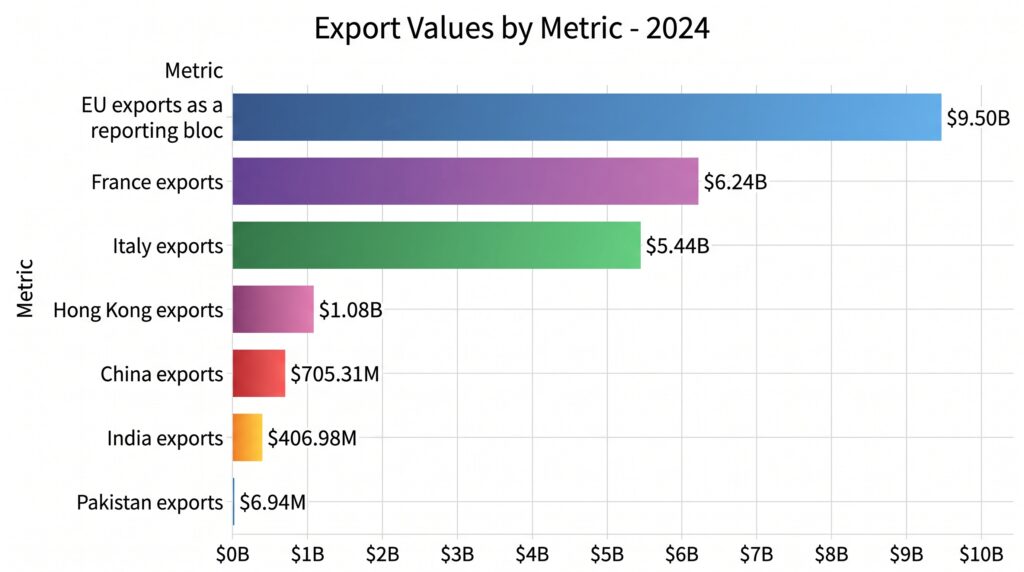
The EU figure is shown separately because it is a regional reporting bloc, not an individual country. It should not be added to France, Italy, or other EU members when creating a country ranking.
Top Leather Handbag Exporters in 2024
France and Italy dominate the individual-country ranking.
| Rank | Country | 2024 Export Value |
| 1 | France | $6.235B |
| 2 | Italy | $5.445B |
| 3 | Hong Kong, China | $1.076B |
| 4 | China | $705.3M |
| 5 | Spain | $576.0M |
| 6 | Singapore | $423.8M |
| 7 | India | $407.0M |
| 8 | Germany | $341.5M |
| 9 | Netherlands | $339.9M |
| 10 | United Kingdom | $338.1M |
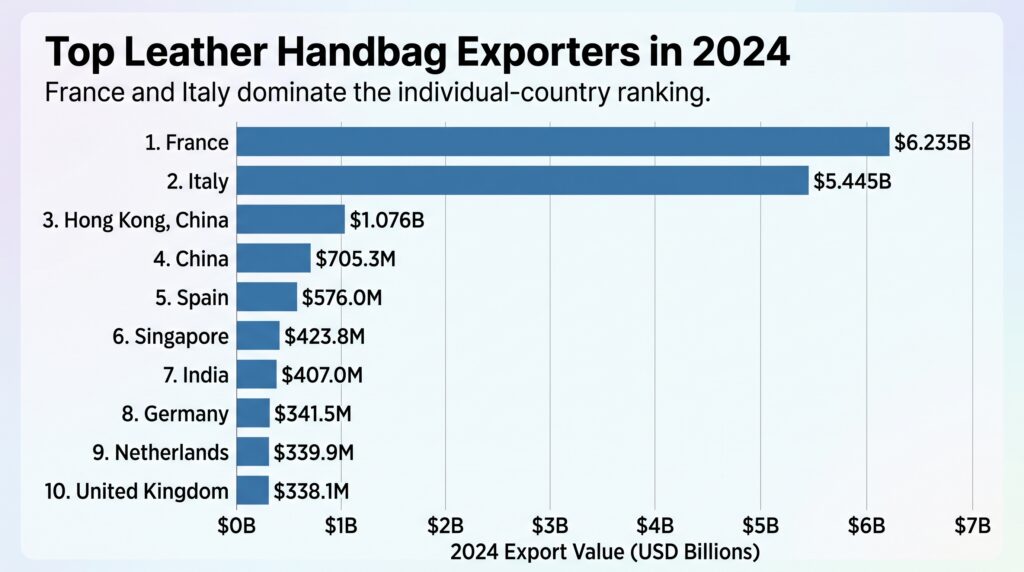
These figures represent gross exports reported under HS 420221, not domestic production. Countries such as Hong Kong and Singapore can therefore appear prominently because international trade and re-export activity can influence their export totals.
France vs. Italy
France recorded the highest individual-country export value at $6.24 billion, while Italy followed at $5.44 billion.
The two countries together accounted for more than $11.6 billion in reported 2024 exports under this classification, illustrating the importance of European luxury and premium leather-bag supply chains.
This should not be interpreted as France and Italy manufacturing every bag they export. Trade statistics measure shipments crossing borders, not necessarily where every product was originally manufactured.
Top Leather Handbag Import Markets
The buyer side presents a different picture.
| Rank | Import Market | 2024 Import Value |
| 1 | China | $2.334B |
| 2 | United States | $2.304B |
| 3 | Hong Kong, China | $1.583B |
| 4 | France | $1.497B |
| 5 | South Korea | $1.174B |
| 6 | Macao | $1.003B |
| 7 | Italy | $968.9M |
| 8 | Japan | $915.6M |
| 9 | Singapore | $663.1M |
| 10 | United Kingdom | $647.1M |
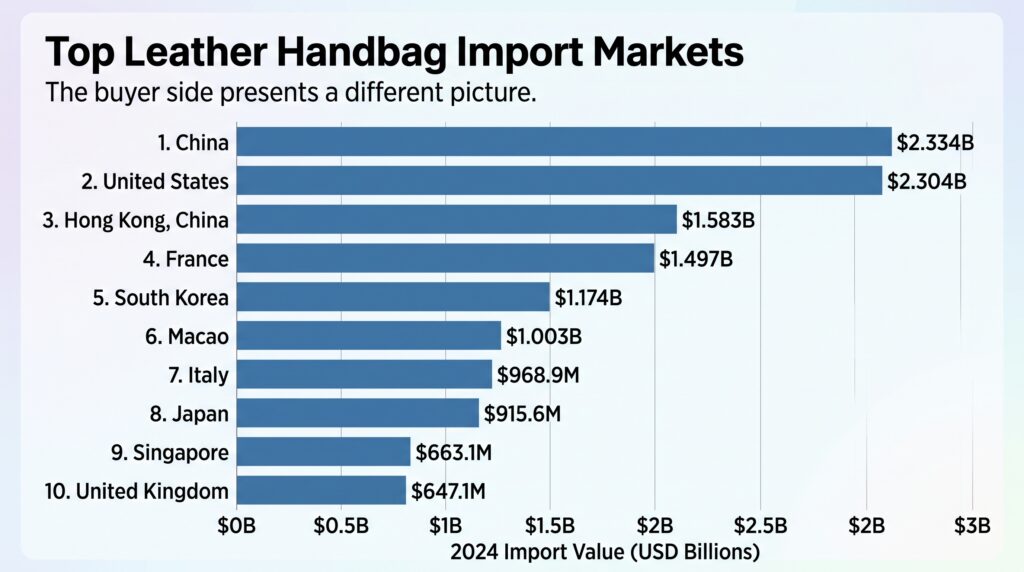
China and the United States were the largest individual-country importers in 2024. France and Italy appear on both the export and import sides, demonstrating how international leather-bag supply chains can involve manufacturing, distribution, re-exporting, and luxury-market trade simultaneously. (World Integrated Trade Solution)
Where Does the United States Source Leather Handbags?
The United States is one of the world’s largest individual import markets, with $2.304 billion in 2024 imports under HS 420221.
For brands entering this market, country-of-origin, product specifications, quality, and landed cost can be more useful sourcing considerations than simply choosing the largest exporting country.
Businesses planning their own product lines can also review our guide to how to start a leather brand.
India’s Leather Handbag Trade
India exported approximately $406.98 million in leather handbags under HS 420221 in 2024.
Its leading destinations included:
| Destination | 2024 Export Value |
| United States | $107.76M |
| United Kingdom | $59.85M |
| France | $37.18M |
| Germany | $33.90M |
| Spain | $31.31M |
| Netherlands | $26.85M |
The United States alone represented more than one-quarter of India’s exports under this classification. (World Integrated Trade Solution)
India’s position is particularly relevant for brands looking for established leather-bag manufacturing and export capabilities.
For businesses evaluating suppliers, our guide on how to source leather products provides a broader sourcing framework.
Pakistan’s Position in Global Leather Bag Trade
Pakistan’s leather industry is significant across several product categories, but its HS 420221 handbag exports were relatively small compared with the major global exporters.
Pakistan exported approximately $6.94 million of handbags under HS 420221 in 2024, equivalent to 691,816 items. Its largest destinations included Italy, Australia, the United States, Germany, and Spain.
This should not be confused with Pakistan’s total leather-product exports. Our Pakistan Leather Industry Statistics covers the country’s broader leather export performance, including gloves, apparel, footwear and finished leather.
What Is the HS Code for Leather Handbags?
The relevant HS classification used in this report is:
HS 420221 — Handbags with outer surface of leather or composition leather.
Using an HS code is important when researching international trade because “leather bags” is a broad commercial term that can cover multiple customs classifications.
Different bag types can fall under different HS codes, so businesses should verify the applicable classification for the exact product before using trade data for sourcing or customs decisions.
Other Leather Bag Trade Categories
Leather bags are not represented by one universal HS code.
For example, other classifications cover different types of luggage, cases, and containers. This means a report using only HS 420221 should be described specifically as a leather handbag trade report, rather than a complete measurement of every leather bag traded internationally.
This distinction is particularly important when comparing future datasets.
For product development and manufacturing models, see our guide to private label leather bags.
What the Trade Data Means for Leather Brands
The 2024 data reveals several useful patterns.
First, export value is highly concentrated. France and Italy were substantially ahead of the other individual exporters under HS 420221.
Second, the largest manufacturing or trading country is not necessarily the largest exporter by value. China exported $705.3 million under this specific classification but ranked behind France, Italy and Hong Kong.
Third, major consumer markets are also trade hubs. China, France, Italy and Hong Kong appear prominently on both import and export data.
Fourth, Pakistan’s leather strength is broader than handbags alone. Its strongest export categories include gloves and apparel, so handbag-specific rankings should not be used to judge the country’s entire leather industry.
Brands evaluating manufacturers should therefore consider product specialization, leather quality, MOQ, production capacity, compliance, and export experience, rather than relying solely on country-level rankings.
Our article on leather supplier vs manufacturer vs trader is useful when evaluating what type of business you are actually sourcing from.
Where Should Brands Source Leather Bags?
There is no single “best” country for every leather-bag project.
A premium luxury brand may prioritize established European manufacturing and finishing capabilities. A brand focused on larger production runs may evaluate Asian manufacturing hubs. Emerging brands may prioritize lower MOQs, private labeling, and flexible product development.
The right choice depends on:
- Leather grade and specification
- Bag construction
- MOQ
- Target price
- Branding requirements
- Production capacity
- Quality-control systems
- Export experience
- Destination-market requirements
Before placing an order, businesses should also know how to verify a leather manufacturer before ordering.
For companies looking to compare manufacturers, suppliers, and exporters across the industry, Tannorium is a dedicated leather marketplace.
Key Findings From the Global Leather Bags Trade Report
The 2024 trade data provides several clear conclusions:
- France was the largest individual-country exporter of HS 420221 leather handbags at $6.24B.
- Italy ranked second at $5.44B.
- China was the largest individual-country importer at $2.33B.
- The United States followed at $2.30B in imports.
- India exported approximately $407M.
- Pakistan exported approximately $6.94M under HS 420221.
- Export and import rankings should not be interpreted as direct production rankings.
- The EU should be treated as a regional reporting bloc, not combined with individual EU countries in rankings.
The biggest lesson is that leather-bag trade is a complex network of manufacturers, exporters, importers, distributors, luxury markets, and re-export hubs, rather than a simple producer-to-consumer flow.
Conclusion
The global leather bags trade report shows a highly concentrated international market for leather handbags, with France and Italy leading individual-country exports in 2024 and China and the United States ranking as the largest individual import markets.
However, HS data must be interpreted carefully. Export value does not equal manufacturing output, and a single HS code does not capture every type of leather bag.
For brands and buyers, the most useful approach is to combine trade data with manufacturer capability, product specialization, quality requirements, MOQ, and sourcing costs before selecting a production country or supplier.
FAQs
Which country makes the best leather bags?
There is no objective single winner. Italy and France are major high-value exporters, while China, India, and other manufacturing hubs serve different segments and production requirements.
How do you know if a leather bag is good quality?
Check the leather grade, grain consistency, stitching, edge finishing, lining, hardware, construction, and overall durability. Our leather grades and quality standards guide provides more detail.
What is the customs code for leather bags?
It depends on the bag type and construction. HS 420221 covers handbags with an outer surface of leather or composition leather.
What is the HS code for handbags?
For handbags with an outer surface of leather or composition leather, the relevant classification used in this report is HS 420221.
Which country is best for leather products?
There is no universal answer. The appropriate sourcing country depends on the product, quality level, production volume, price target, and manufacturing requirements.
Who is the largest exporter of leather bags?
For HS 420221 leather handbags, France was the largest individual-country exporter in 2024 at approximately $6.24 billion, followed by Italy at $5.44 billion.
Is there a tariff on leather goods?
Tariffs depend on the destination country, product classification, country of origin, and applicable trade agreement. Businesses should check the tariff applicable to their exact HS classification before importing.
What is the HS code for leather?
There is no single HS code covering all leather. Raw hides, finished leather, handbags, footwear, jackets, and other products are classified under different HS headings.
What is the HS code for leather bags in Pakistan?
The applicable code depends on the exact bag and its material. For handbags with an outer surface of leather or composition leather, this report uses HS 420221. Importers should verify the applicable Pakistani tariff classification for the specific product.
Leather Industry Events 2026: Upcoming Trade Shows

Leather Industry Events 2026 become especially important from September onward, with major exhibitions scheduled in China, It...
Pakistan Leather Industry Statistics 2026: Exports, Products & Trade
Pakistan leather industry statistics show that Pakistan exported $848.26 million in leather and leather products during FY202...
Top Leather Producing & Exporting Countries in 2026
The top leather producing & exporting countries are not necessarily the same. Production depends largely on the supply of...
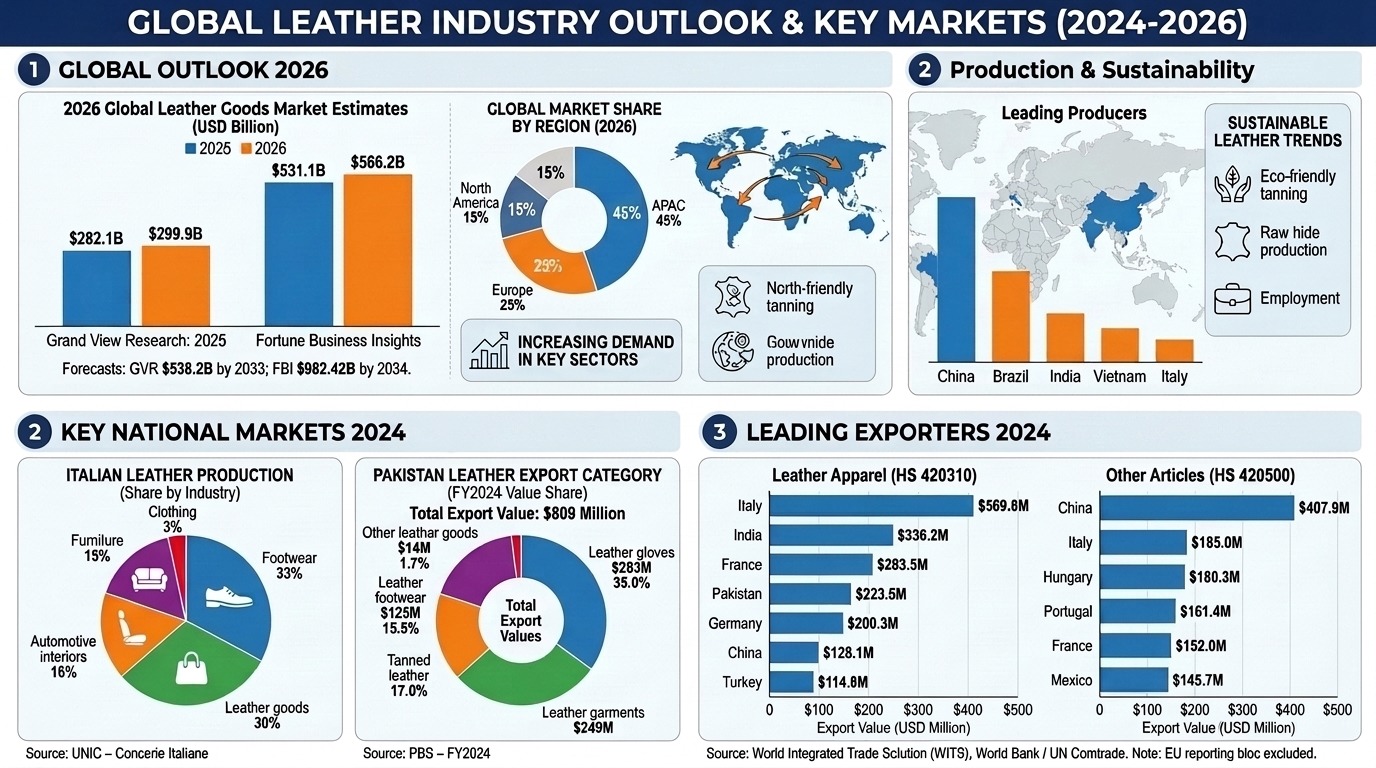
The Global Leather Industry in 2026: Market Size, Production, Trade & Statistics
The global leather industry in 2026 spans a much larger value chain than leather jackets, handbags, and footwear. It begins w...

Leather Supplier vs Manufacturer vs Trader: 7 Key Differences Buyers Should Know
Leather supplier, manufacturer, and trader are terms you will frequently encounter when sourcing leather goods, but they don'...
Best Leather Manufacturers in the World (2026 List)
Finding the best leather manufacturers is one of the most important decisions for any business selling leather products. Whet...
OEM vs Private Label Leather Manufacturing: Which Is Right for Your Brand?
Choosing the right manufacturing model is one of the most important decisions when launching or expanding a leather brand. Wh...
Understanding Leather Grades and Quality Standards
Leather is one of the few materials whose value depends as much on how it is made as on what it is made from. Terms such as f...