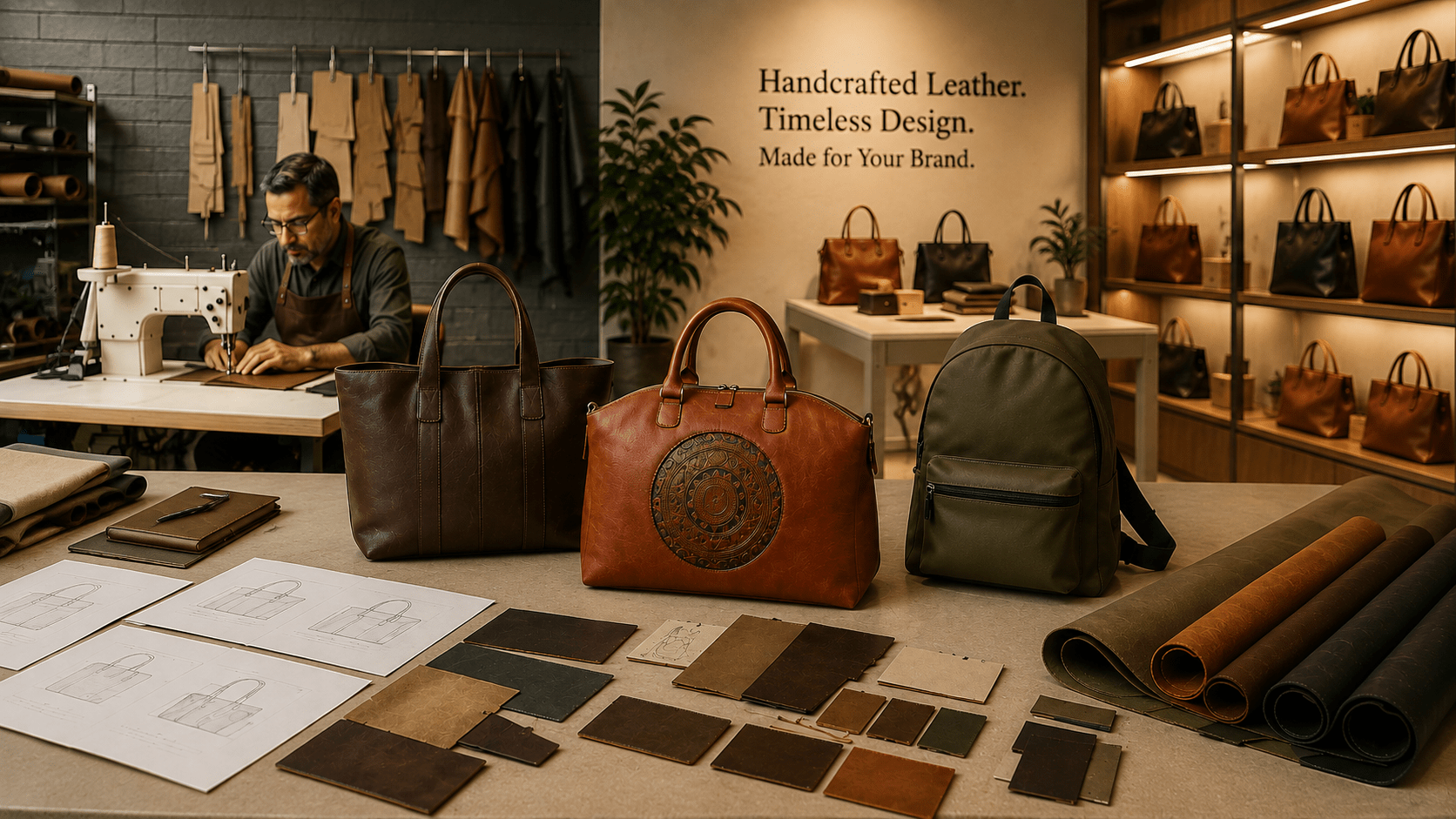
Choosing the right leather manufacturer can directly affect your product quality, production costs, consistency, and brand reputation. A manufacturer is not simply a production partner; they can influence how your finished products look, perform, and scale as your business grows.
Before committing to a manufacturer, brands should evaluate leather quality, manufacturing capabilities, customization options, MOQ, quality control, pricing, lead times, and communication. The right choice should match both your current requirements and your long-term production needs.
What Should You Look for in a Leather Manufacturer?
A reliable manufacturer should be able to consistently meet your product specifications while providing clear production terms. Key areas to evaluate include:
- Leather quality and sourcing
- Manufacturing capabilities and experience
- Product customization
- Quality-control procedures
- MOQ and production capacity
- Pricing and payment terms
- Lead times and communication
- Samples and prototypes
A manufacturer that performs well across these areas can reduce production problems and make it easier to maintain consistent product quality.
Factors to Consider Before Choosing a Leather Manufacturer
Leather Quality and Material Options
The leather used in your products should match your brand’s quality and positioning. Ask what types of leather the manufacturer offers, such as full-grain, top-grain, genuine leather, or suede.
Also confirm the leather’s thickness, finish, color options, consistency, and sourcing. If you require a particular leather specification, make sure it can be maintained across production batches.
Manufacturing Experience and Capabilities
Look for manufacturing experience relevant to your specific product category. A company experienced in leather bags, for example, may not have the same capabilities for jackets, footwear, or highly structured accessories.
Ask whether production is handled in-house or outsourced and whether the manufacturer has sufficient capacity to meet your expected order volume.
Customization and Private Label Services
If you are developing your own product line, confirm what customization services are available. These may include:
- Custom designs and dimensions
- Private labels and branding
- Embossing or debossing
- Custom hardware
- Custom colors
- Branded packaging
A capable Leather Manufacturer should be able to clearly explain which custom requirements can be produced and whether they affect MOQ, pricing, or lead time.
Minimum Order Quantity (MOQ)
MOQ is the minimum quantity a manufacturer requires for a production order. It can vary depending on the product, materials, customization, colors, and production setup.
Ask whether the MOQ applies to the entire order, each product, design, or color. Smaller brands and startups should also confirm whether the manufacturer offers small-batch or trial production.
Samples and Prototypes
Always consider ordering a sample before moving to bulk production. A sample allows you to evaluate the actual leather, stitching, hardware, dimensions, construction, and overall workmanship.
Compare the sample against your specifications and communicate any required revisions before approving the final production version.
Quality Control and Production Standards
Quality control is essential for maintaining consistency across a production run. Ask how the manufacturer inspects materials, workmanship, measurements, stitching, hardware, and finished products.
Also clarify how defective products are handled and whether inspections take place during production, before shipment, or at both stages.
Pricing, Lead Times, and Payment Terms
Do not evaluate manufacturers based only on their quoted unit price. Calculate the complete production cost, including:
- Product manufacturing
- Sampling and tooling
- Customization
- Packaging
- Shipping
- Applicable import costs
Confirm the expected production timeline and payment milestones before placing an order. A low price may not be beneficial if it comes with poor quality, extended lead times, or unexpected charges.
Communication and Reliability
Clear communication is important throughout product development and production. A dependable manufacturer should provide accurate information, respond within a reasonable timeframe, share relevant production updates, and communicate potential delays early.
The manufacturer’s ability to meet agreed specifications and deadlines is just as important as the initial quotation.
What Questions Should You Ask a Leather Manufacturer?
Before placing an order, ask:
- What types of leather do you work with?
- Where is your leather sourced?
- What is your MOQ?
- Can you produce custom designs?
- Do you offer private labeling?
- Can I order a sample first?
- What is your production lead time?
- What quality-control process do you follow?
- What are your payment terms?
- Can you provide examples of previous work?
Clear answers to these questions can help you compare manufacturers and identify potential production issues before committing to a large order.
How Do You Know if a Leather Manufacturer Is Reliable?
Several factors can help you assess reliability:
- Consistent and clear communication
- Transparent pricing
- Professional samples
- Verifiable manufacturing capabilities
- A defined quality-control process
- Realistic production timelines
- Clear documentation of production terms
Where possible, review physical samples and verify the manufacturer’s actual production capabilities rather than relying solely on claims or product photographs.
Leather Manufacturer vs. Leather Supplier: What’s the Difference?
| Manufacturer |
Supplier |
| Produces finished leather goods |
Usually supplies materials or finished products |
| Can support custom production |
Customization may be more limited |
| May offer private-label manufacturing |
Private labeling depends on the supplier |
| Suitable for brands developing products |
Often suitable for sourcing materials or ready-made products |
The right option depends on what your business needs. Brands developing their own products generally need stronger manufacturing and customization capabilities, while businesses sourcing leather or ready-made goods may work with suppliers.
Conclusion
Choosing a leather manufacturer should involve more than comparing unit prices. The manufacturer should be able to consistently meet your quality requirements, production volume, customization needs, and delivery expectations.
Evaluate quality, MOQ, samples, customization, pricing, lead time, quality control, and communication together. A manufacturer that fits your current requirements while supporting future growth can provide a more stable foundation for your leather brand.
FAQs
How do I find a reliable leather manufacturer?
Research manufacturers based on their experience, product capabilities, material options, samples, quality-control process, MOQ, pricing, and production history. Always verify important claims before placing a bulk order.
What should I ask a leather manufacturer before placing an order?
Ask about leather sourcing, material specifications, MOQ, customization, samples, quality control, production lead time, payment terms, and previous manufacturing experience.
What is a typical MOQ for leather products?
There is no universal MOQ. It varies according to the manufacturer, product type, materials, customization, colors, and production requirements.
Should I order a sample before bulk production?
Yes. A sample lets you evaluate the leather, construction, dimensions, stitching, hardware, and workmanship before committing to bulk production.
How can I verify a leather manufacturer’s quality?
Request samples, examine the construction and materials, ask about quality-control procedures, review previous work, and confirm that the manufacturer can consistently meet your product specifications.