State of the Leather Industry analysis in 2026 shows a large, expanding global market, but the headline numbers vary considerably depending on what each research firm includes in “leather goods.” Current 2026 estimates range from $299.9 billion to $566.23 billion, while published forecasts point to continued growth through the early 2030s. This report compares the available 2026 figures, examines production and trade trends, and uses the reported growth rates to develop a calculated 2027–28 outlook.
Global Leather Industry Market Size in 2026
Two major 2026 market studies illustrate why market-size figures should not be treated as interchangeable.
| Research basis |
2026 estimate |
Published CAGR |
Long-term forecast |
| Grand View Research |
$299.9B |
8.7% |
$538.2B by 2033 |
| Fortune Business Insights |
$566.23B |
7.13% |
$982.42B by 2034 |
The difference is primarily a matter of market definition, segmentation, and research methodology, rather than evidence that one figure is necessarily incorrect. For a reliable State of the Leather Industry growth report, these estimates should therefore be presented as separate research benchmarks.
State of the Leather Industry Growth Statistics
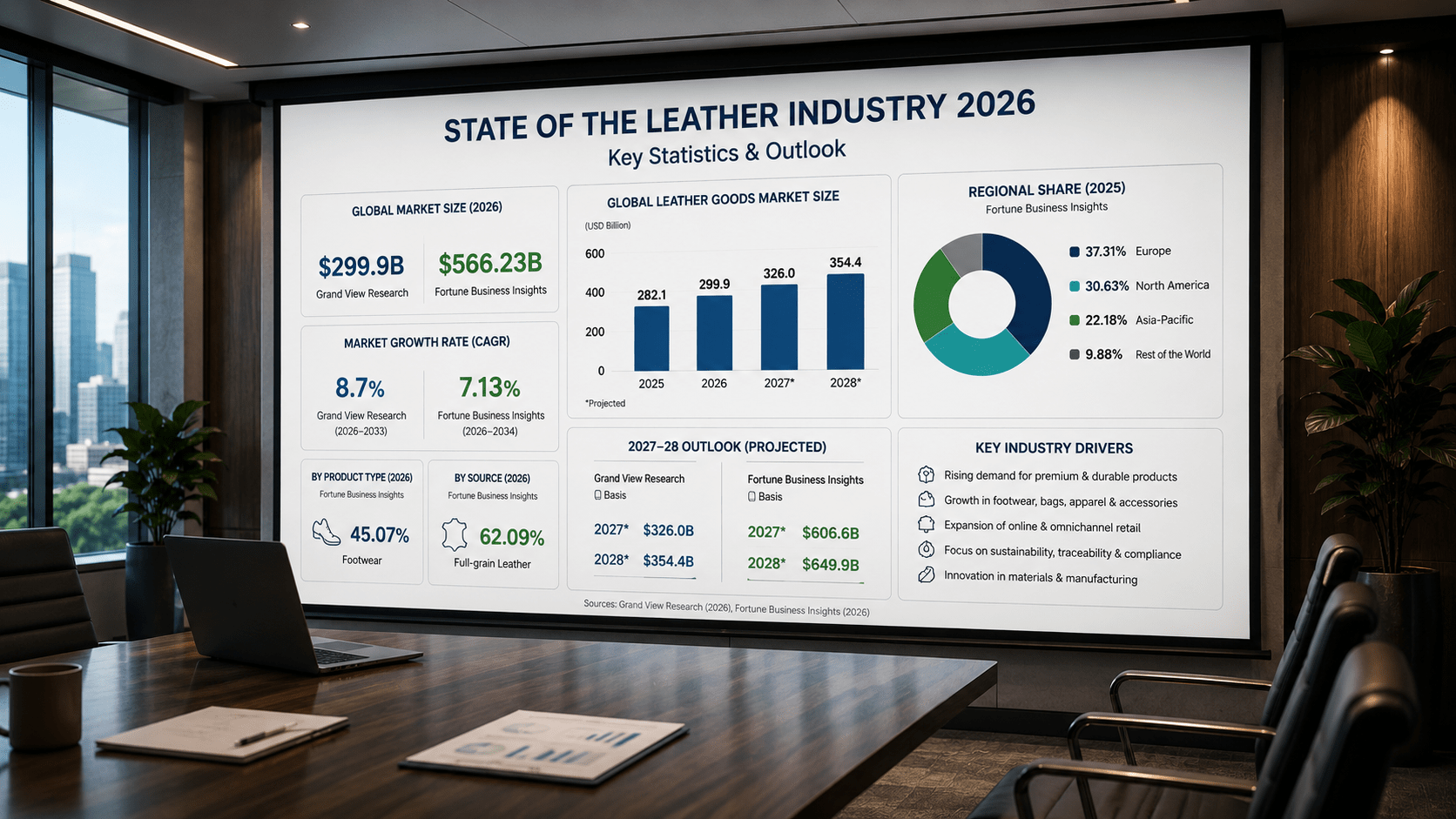
The 2026 data points to continued expansion. Fortune Business Insights estimates that its defined market increased from $531.07 billion in 2025 to $566.23 billion in 2026, an increase of approximately 6.6% year over year. Its longer-term forecast uses a 7.13% CAGR through 2034.
Grand View Research places its 2026 market estimate at $299.9 billion, following a 2025 value of $282.1 billion. That represents approximately 6.3% year-over-year growth, with an 8.7% CAGR projected for 2026–33.
These figures indicate that the State of the Leather Industry growth rate remains positive, although the precise rate depends on the market definition being measured.
Regional State of the Leather Industry
The industry is geographically diverse. Fortune Business Insights estimates that Europe accounted for 37.31% of its global leather goods market in 2025, followed by North America at 30.63% and Asia-Pacific at 22.18%. Its 2026 estimates put Europe at approximately $210.45 billion, North America at $173.93 billion, and Asia-Pacific at $126.64 billion.
This creates an important distinction between consumption, manufacturing, and exports. A country can have a major leather manufacturing base without being the largest consumer, while another can dominate luxury consumption without producing the greatest physical volume.
Our earlier Top Leather Producing/Exporting Countries in 2026 examines these differences by country.
Production, Trade and Product Demand
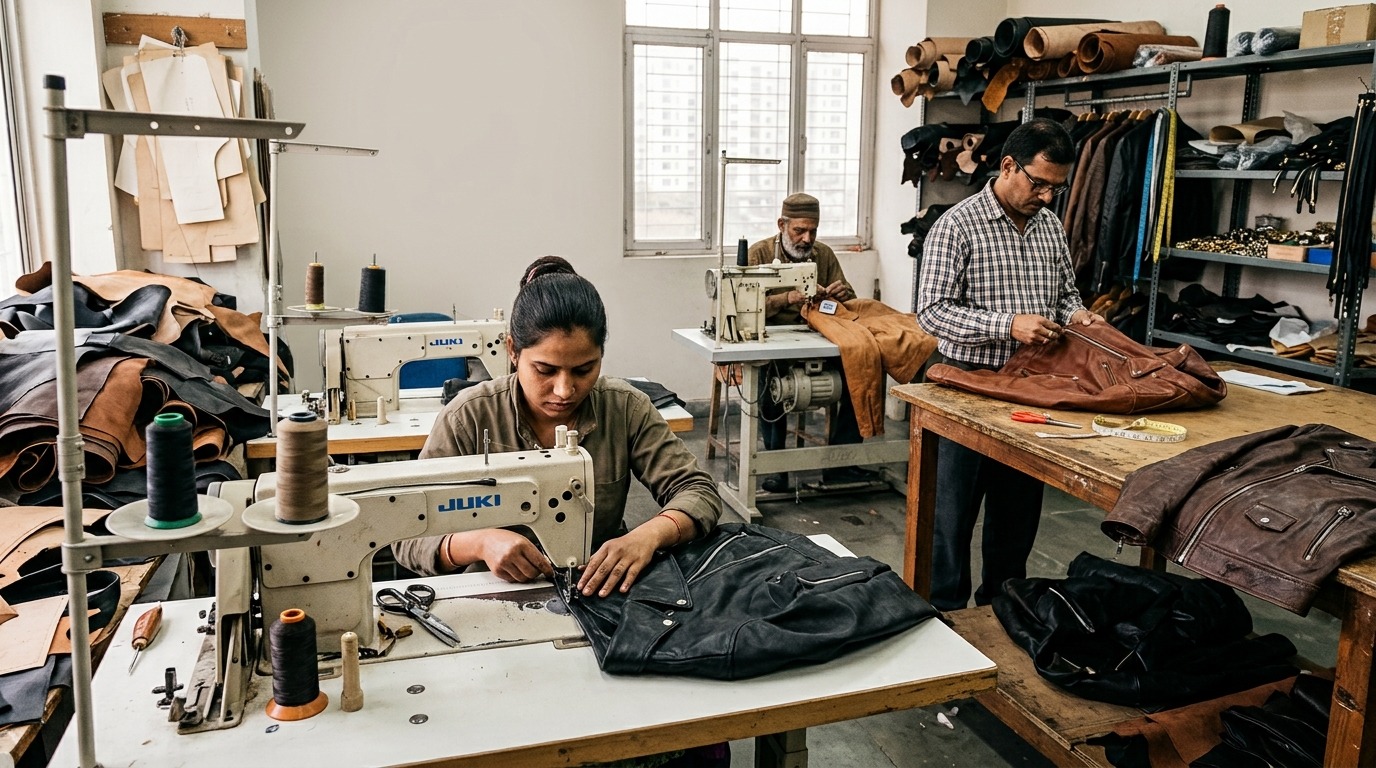
Leather remains concentrated across several major production and manufacturing regions, particularly Asia, Europe and Latin America. China, India, Brazil, Italy and other established leather economies occupy different positions across raw hides, tanning, finished leather and manufactured goods.
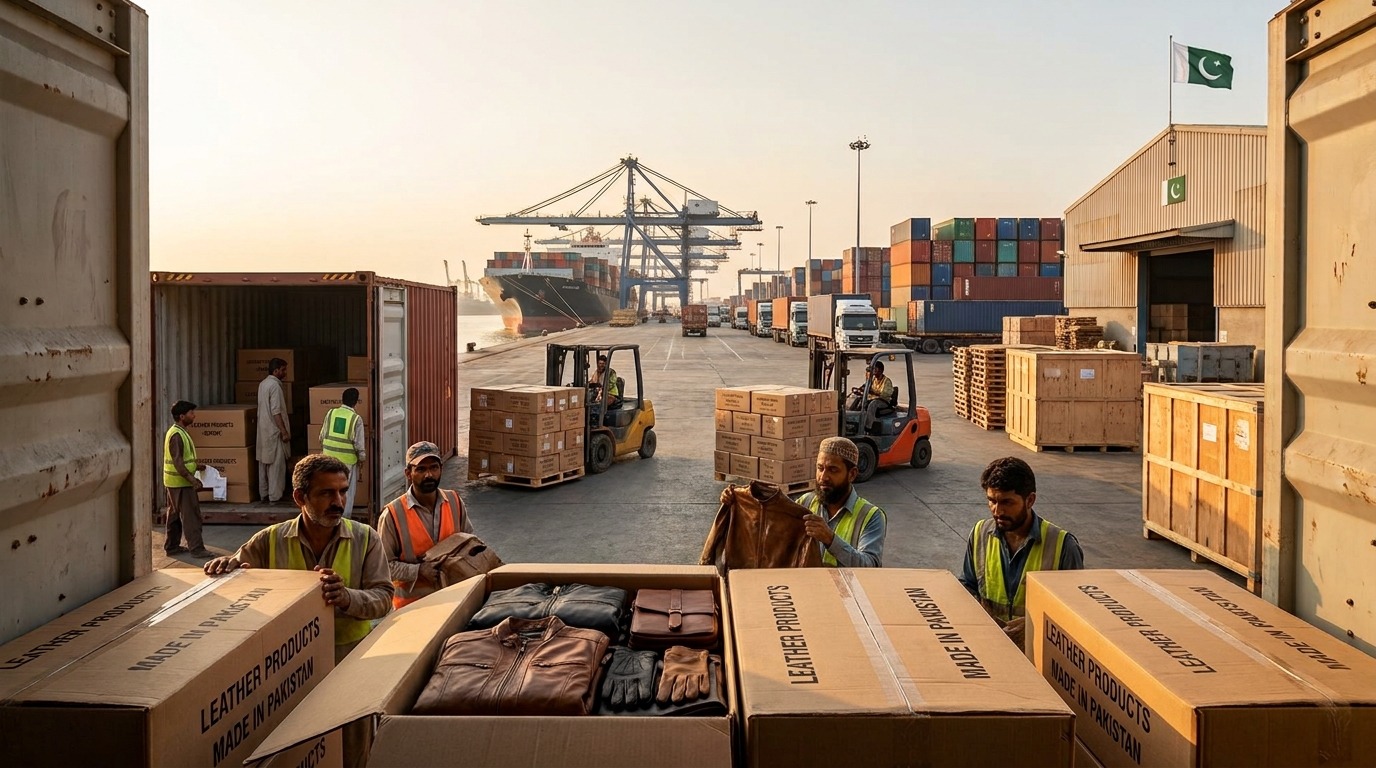
Trade performance also differs by product classification. Our Global Leather Bags Trade Report provides a more specific view of international leather-bag trade, while our Pakistan Leather Industry Statistics examines one important manufacturing and export market in greater detail.
At the product level, footwear remains particularly significant. Fortune Business Insights estimates footwear represented 45.07% of its leather-goods market in 2026, while full-grain leather represented 62.09% by source. (Fortune Business Insights)
What Is Driving the Industry in 2026?
The State of the leather industry growth is being supported by several structural factors:
- Demand for durable and premium products.
- Expansion of luxury and branded leather goods.
- Growing online and omnichannel retail.
- Product customization and smaller specialist brands.
- Continued demand for footwear, apparel, luggage and accessories.
- Investment in alternative materials and improved processing technologies.
At the same time, sustainability, chemical management, traceability and environmental compliance are becoming increasingly important. These pressures are changing how manufacturers approach tanning, sourcing and product development.
Businesses entering the sector can also review our guides on how to start a leather brand and how to source leather products before making sourcing decisions.
2027–28 Leather Industry Outlook
Using the published 2026 estimates and their respective CAGRs, we can calculate a simple baseline outlook.
| Market benchmark |
2026 |
2027* |
2028* |
| Grand View Research basis |
$299.9B |
$326.0B |
$354.4B |
| Fortune Business Insights basis |
$566.23B |
$606.6B |
$649.9B |
*2027–28 values are calculated projections, not published forecasts, using each research firm’s stated CAGR.
This analysis suggests that, if current growth assumptions broadly hold, the global market could add approximately $26–40 billion in 2027 and another $28–43 billion in 2028, depending on the market definition.
The more important conclusion is direction rather than a single absolute number: continued moderate-to-high growth is the central 2027–28 scenario, while sustainability requirements, consumer preferences, alternative materials, input costs and international trade conditions remain key variables.
State of the Leather Industry by Country
Country performance should be assessed using comparable metrics rather than a single ranking. Production volume, finished-leather output, leather-goods manufacturing, and export value measure different parts of the industry.
For country-specific context, our reliable leather manufacturers in Pakistan article and best leather manufacturers in the world provide additional industry-level context.
What the 2026 Data Means for Businesses
The 2026 State of the Leather Industry points toward a market that is expanding but becoming more sophisticated. Manufacturers and brands will increasingly compete on quality, traceability, design, production efficiency, compliance, and product differentiation, rather than leather availability alone.
For companies looking to connect with suppliers, manufacturers and buyers, Tannorium provides a dedicated leather marketplace for the global leather industry.
Conclusive Thoughts
The State of the Leather Industry 2026 is best understood through multiple indicators rather than one market-size figure. Current research places the 2026 leather-goods market between approximately $299.9 billion and $566.23 billion, with both major estimates projecting continued growth.
Our analysis of the available 2026 growth rates produces a 2027–28 baseline of roughly $326–354 billion under the Grand View Research methodology and $607–650 billion under the Fortune Business Insights methodology. These are calculated scenarios, not guaranteed outcomes.
The broader direction is clear: leather remains a major global materials and consumer-goods industry, while sustainability, technology, international trade and changing consumer demand will increasingly determine where its next phase of growth occurs.
FAQs
Who are the biggest leather producers in the world in 2026?
China, Brazil, Italy, India and Russia are among the major leather-producing countries, although rankings depend on whether raw hides, finished leather or manufactured leather goods are being measured.
What are the top leather exporting countries?
Italy, China, India, France, Pakistan, Germany and other major manufacturing economies are important exporters, but rankings vary significantly by HS product classification.
What is the current state of the global leather industry?
The industry is growing in 2026, supported by footwear, luxury goods, apparel, luggage and accessories, while sustainability and alternative materials are creating new competitive pressures.
What is the State of the Leather Industry growth rate?
Published 2026 market studies currently report CAGRs of approximately 7.13% to 8.7%, depending on the market definition and forecast period.
What is the outlook for the leather industry in 2027–28?
If the published 2026 growth assumptions remain broadly valid, continued expansion is likely through 2027–28. Our calculated scenarios indicate market growth in both years, although actual results will depend on demand, trade, costs, and regulatory conditions.
Which country is famous for high-quality leather?
Italy is particularly associated with premium and luxury leather processing, while countries such as China, India, Brazil, and Pakistan have important production and manufacturing capabilities.